Sales, Production, Cash Flow: Why UK Manufacturers Need All Three Moving Together
There's a moment a lot of manufacturers know a bit too well. Sales land a great new order. Everyone's pleased. Then production works out it needs three weeks of lead time you don't have, and finance quietly points out that the deposit won't land until after you've already paid for the raw material. Nobody did anything wrong exactly. It's just that three parts of the same business were pulling in three different directions at once.
That's the thing about growth. It sounds like one word, one clean upward line on a chart. In reality it's three separate systems, sales, production and cash flow, all trying to move at the same speed without falling over each other. When they're synced, growth feels almost easy. Orders come in, the factory absorbs them, cash follows behind at a pace you can plan around. When they're not synced, and to be honest most businesses live here more than they'd like to admit, growth actually starts to hurt. You win the order and lose the cash. You protect the cash and lose the customer. You keep production humming and end up with a warehouse full of stock nobody's paying for yet.
We call this the Growth Triangle. Three points, sales, production, cash flow, each one only as strong as its weakest connection to the other two. This post is about what happens when you actually treat it as a system rather than three departments who happen to share a building. If you run or manage a mid-sized manufacturing business in the UK, this is probably a conversation you're already half having in your head. Let's finish it properly.
Why the three pillars drift apart in the first place
Here's a slightly uncomfortable truth. Most manufacturing businesses aren't badly run. They're run by capable people who are each optimising for their own bit of the business. Sales gets measured on orders won. Production gets measured on efficiency and output. Finance gets measured on margin and, increasingly, on whether the business can actually pay its bills. Three sensible goals that, left alone, will quietly compete with each other every single week.
The UK backdrop makes this worse right now, not better. There's genuine optimism in the sector at the moment, manufacturing output has been picking up and export orders are improving for the first time in years. That's the good news. But underneath that recovery, a lot of mid-market and smaller manufacturers are still carrying thin working capital buffers and are more exposed to cash flow stress than the headline numbers suggest. So, you've got businesses feeling more confident about winning work at exactly the moment their financial cushion is thinnest. That's a dangerous combination if the three pillars aren't talking to each other.
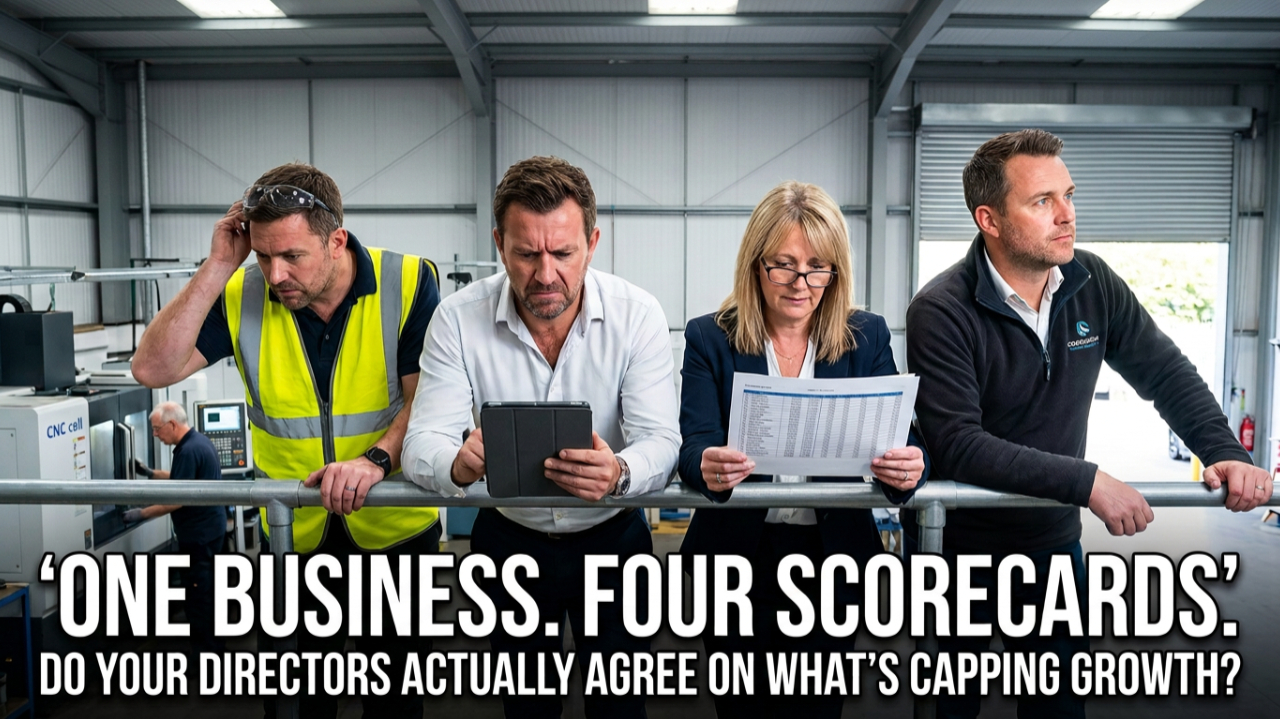
I think the honest starting point is admitting that most businesses don't have a systems problem, they have a communication problem wearing a systems costume. Sales doesn't tell production about a pipeline deal until it's basically signed. Production doesn't tell finance about a machine that's about to need replacing until it breaks. Finance doesn't tell sales that payment terms on the next big account will actually strangle cash flow for two months, because nobody asked. Each function is doing its job well in isolation. The triangle only breaks because nobody's looking at all three sides at once.
And look, I get why. Weekly meetings are exhausting enough without adding another one. But the alternative is what a lot of manufacturers are living through right now, where over half of mid-market firms say cost pressures are their biggest barrier to growth and cash flow pressure is holding almost as many back, even while order books are healthier than they've been in a while. That's not a demand problem. That's a synchronisation problem.
When sales runs ahead of production
Let's start with the pillar that usually moves first. Sales, by nature, is optimistic. It has to be. Nobody closes deals by dwelling on capacity constraints. But that optimism, left unchecked, is where a lot of the trouble starts.
I've sat in enough of these conversations to know the pattern. A sales team lands a big order, maybe even a genuinely brilliant one, and promises a delivery date that sounds reasonable on the surface. Four weeks feels generous, doesn't it? Except nobody checked whether the machine that makes that particular component is already booked solid for the next three weeks on other orders. Or whether the raw material has a six-week lead time because of a supplier issue nobody flagged. Suddenly you're not delivering a great order, you're firefighting one, and the customer who was thrilled two weeks ago is now your most stressful phone call of the day.
This is where UK manufacturers are feeling supply chain volatility especially sharply at the moment. Disruption on major freight routes and rising input costs mean lead times aren't as predictable as they used to be, and manufacturers running lean, just in time models have very little buffer when materials arrive late or prices move without warning. A sales promise made without checking production reality isn't just optimistic anymore, it's genuinely risky.
The fix here isn't complicated, though it is a bit of a culture shift. Sales needs visibility into production capacity before it promises a date, not after. Not a formal report nobody reads, just an honest, current picture of what the shop floor can actually absorb this month and next. In my experience, the businesses that get this right usually just put a rolling capacity view somewhere sales can see it themselves, updated weekly, nothing fancy. It stops the awkward conversation happening after the order is signed, which is always the worst time to have it.
I remember sitting in on a review at a small metalwork firm where the sales director genuinely didn't know the finishing line had been down for repairs for four days. Nobody had told him because, well, why would they, that's a production problem, not a sales one. Except he'd promised a customer delivery for that exact week, based on the old lead time in his head. It wasn't malicious or careless. It was just two people looking at two different versions of reality, both perfectly reasonable from where they were standing. That's usually all it takes.
When production runs ahead of cash
Now flip it. Production has its own version of this problem, and it's a sneaky one because it often looks like good management on the surface.
Efficient production usually means longer runs, bulk purchasing, and keeping machines busy rather than idle. All sensible. Except every one of those decisions ties up cash. Stock sitting in the warehouse isn't an asset in any way that helps you make payroll on Friday. It's cash, frozen, waiting for someone to buy it. A production team optimising purely for efficiency will quite happily build three months of stock if it makes the numbers look tidy on a production report, without necessarily thinking about what that does to the working capital cycle.
This is genuinely one of the trickiest parts of the triangle because the incentives are so misaligned. Production efficiency and cash efficiency often pull in opposite directions. Longer runs lower unit cost but raise inventory. Holding safety stock protects you against supply disruption but locks up money that could be doing something else. There isn't a universally right answer here, it depends on your margins, your customers, and how volatile your supply chain actually is. But the businesses that get into trouble are the ones where nobody's even asking the question. Production just keeps producing because that's what production does.
There's a working capital finance guide aimed at UK manufacturers that puts this quite plainly: the point of a cash flow forecast isn't just to record what's happened, it should map out when materials get bought, when production costs land, when goods actually go out the door, and when the customer's money finally arrives. That timeline, laid out properly, tends to be a bit of a wakeup call. A lot of manufacturers assume their cash cycle is roughly thirty days because that's the invoice term. Actually map it out and you often find it's closer to sixty or seventy-five once you account for how long stock sits before it moves and how long customers actually take to pay once it's delivered.
Maybe the simplest thing you can do here is start treating stock as a decision, not a default. Before a big production run gets scheduled, someone should be asking what that does to cash tied up over the next month, not just what it does to unit cost. It doesn't need to block the decision. It just needs to be part of it.
Cash flow as the pillar everyone reacts to instead of plans around
This is the one that tends to get treated as the scoreboard rather than a player in the game, and I think that's the core mistake. Cash flow ends up being the thing you check at the end of the month to see how the other two pillars performed, rather than something that actively shapes what sales and production do in the first place.
The UK late payment culture doesn't help. Recent figures show overdue invoices on UK books have kept climbing, and the pattern is depressingly familiar, a profitable business on paper whose customers pay in sixty to ninety days while its own suppliers, HMRC and payroll all want paying on time. You can be growing and still be in genuine trouble because the gap between money going out and money coming in has quietly stretched. That's not a hypothetical, that's what a lot of profitable mid-sized manufacturers are actually navigating right now.
A rolling thirteen-week cash flow forecast sounds like a finance department exercise, and I suppose technically it is, but it works best when sales and production feed into it directly rather than finance guessing. Sales should be feeding in what's actually likely to close, not the whole pipeline dressed up as certain. Production should be feeding in what materials need paying for and when. Once that forecast is genuinely current, and it only needs updating weekly, cash stops being a surprise and starts being something you can plan three months ahead of. That shift alone changes the tone of a business. You stop reacting to a bank balance and start managing towards one.
There's also a slightly less obvious point here. Late payment isn't just annoying, it constrains what sales and production are allowed to do. If you know a big customer sits at seventy-five days, that should genuinely influence whether you take on another large order that needs materials paid for up front. Not block it necessarily, but inform it. Cash flow, done properly, isn't the department that says no. It's the department that tells you what yes actually costs.
Building the actual triangle
So how do you actually get these three pillars talking to each other without turning your business into a meeting factory? Honestly, it doesn't need to be complicated, and I'd argue overcomplicating it is exactly how these initiatives die within a quarter.
Start with a single recurring conversation, weekly is usually right for most mid-sized manufacturers, monthly is too slow given how fast things move now. Sales brings what's realistically closing in the next four to six weeks. Production brings current capacity and any material or supplier risks on the horizon. Finance brings the rolling cash position and forecast. Half an hour, same time every week, same three people or their delegates.
That's it. It's not glamorous. But it's the mechanism that stops each pillar quietly drifting off and making decisions in isolation.
The businesses that do this well tend to share a few habits. They use one shared number for demand, not three different versions living in three different spreadsheets. They flag risk early rather than waiting for it to become a problem, a machine that needs servicing, a customer whose payment is slipping, a supplier whose lead time has crept up. And critically, they let the cash forecast actually influence decisions upstream, not just record them after the fact.
Technology helps here but it isn't the point. A shared spreadsheet updated properly beats an expensive system nobody trusts. What matters is that everyone's looking at the same current picture rather than the version that was true three weeks ago. If you're already keeping digital records for Making Tax Digital, that same data can often feed straight into a rolling forecast with very little extra work, which is honestly a bit of low hanging fruit a lot of manufacturers haven't picked yet.
And I'll be honest, this won't fix itself in one meeting. It took most businesses years to drift into silos, it'll take a few months of consistent habit to pull them back together. But the manufacturers who get this right tend to describe the same thing happening. Growth stops feeling like a series of near misses and starts feeling like something they can actually steer.
Bringing it together
The Growth Triangle isn't a clever framework designed to sound impressive in a meeting. It's really just a reminder that sales, production and cash flow were never meant to operate as separate departments chasing separate targets. They're one system. When one moves without the other two, something eventually gives, a missed delivery, a cash squeeze, a warehouse full of stock nobody wants yet.
You've probably recognised at least one of these patterns in your own business while reading this. Maybe it's sales promising dates production can't hit. Maybe it's stock quietly eating cash you didn't realise was gone. Maybe it's a cash position that only gets attention when it's already tight. None of that makes you badly run, it makes you fairly normal in UK manufacturing right now, where confidence is genuinely returning but working capital buffers are still thin for a lot of mid-sized firms.
The good news is that fixing this doesn't require a huge system overhaul or a six-figure investment in software. It starts with something much smaller, get the three pillars looking at the same numbers, in the same room, on the same schedule. Let sales see real capacity before it promises a date. Let production weigh cash, not just efficiency, before scheduling a big run. Let cash flow shape decisions upstream instead of just reporting on them after the fact.
Do that consistently and something genuinely useful happens. The three pillars stop working against each other and start reinforcing one another instead. Growth becomes less about winning the next order and hoping the rest of the business keeps up, and more about a business that's actually built to absorb it. That's the whole point of the triangle. Not three separate jobs done well. One system, moving together.
Ready to see where your own triangle is out of sync?
Reading this is one thing. Actually sitting down with your sales, production and finance numbers side by side is another, and honestly that's where most of the useful insight tends to show up. Not in another report, in the room, when someone finally says the quiet part out loud.
That's exactly what our Strategy SPRINT workshop is built for. In a single focused session, we'll map your three pillars together, sales pipeline, production capacity and cash position, and show you exactly where they're pulling apart and what that's actually costing you in delayed orders, frozen stock or tight months you didn't see coming. No generic advice, no thick slide deck to file away and forget. Just your numbers, your business, and a clear set of next steps you can put into action the same week.
If you've read this far, you've probably already got a fair idea which pillar in your business needs the attention first. Let's find out for certain.
Book your
Strategy SPRINT workshop
today and get your sales, production and cash flow working as one system, not three.
Pay It Forward! Sharing Is Caring!