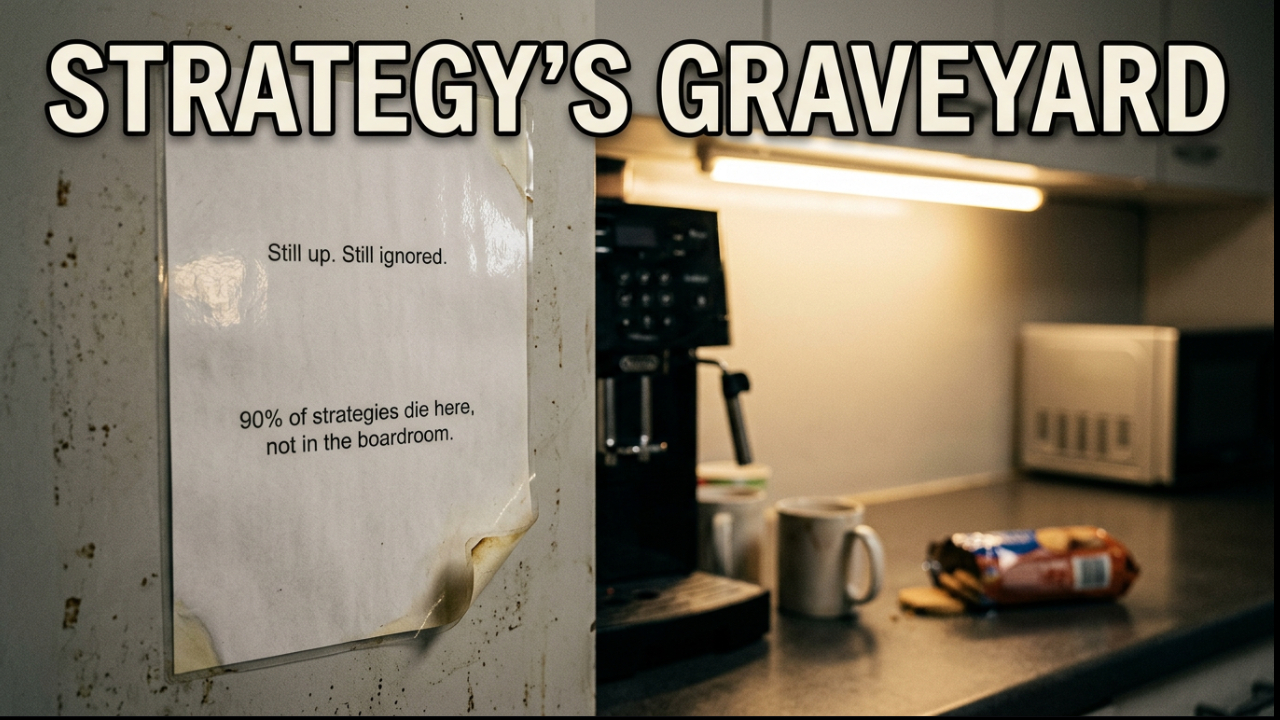
Strategy looks brilliant when you’re standing in front of a whiteboard with a fresh cup of coffee and uninterrupted time. You map out the year, set bold ambitions for your manufacturing business, and everyone in the leadership team nods in agreement. You feel aligned, energised, and optimistic about what the business could achieve.
Then Monday morning arrives.
A critical machine goes down. A supplier misses a delivery. Production slips. A customer chases an urgent order. Suddenly, that beautiful annual strategy is buried under a pile of operational fires.
That’s the reality for most manufacturing and engineering businesses. Strategy often looks strong in the planning room but struggles to survive contact with the factory floor. The pace of day-to-day operations is too fast, too unpredictable, and too demanding for a twelve-month plan to carry the full weight of execution.
The problem is not ambition. The problem is
distance. The further a goal sits from the daily reality of the business, the easier it is for it to drift, lose urgency, and disappear behind more immediate pressures. By the time you get to the point of revisiting the annual plan, too much time has passed, priorities have shifted, and momentum has been lost.
That’s why high-performing technical businesses need a better system. Instead of treating strategy as a once-a-year event, you need to turn it into a practical quarterly execution rhythm. That is what a 90-day execution plan does. It turns big ideas into focused action, gives leaders clearer ownership, and creates measurable momentum every quarter.
In this article, I’ll show you how to build one.
What a 90-Day Execution Plan actually is
A 90-day execution plan is not a full business plan, and it is not a long list of everything the business would like to improve. It is a short-cycle management tool that translates your annual strategy into a small number of immediate priorities.
Think of it as the bridge between the boardroom and the factory floor.
It takes the bigger picture and turns it into something the leadership team can actually deliver in the next quarter. That matters in manufacturing and engineering businesses, where long lead times, cross-functional dependencies, and constant operational pressure can make annual planning feel detached from reality.
A 90-day plan also creates a useful rhythm. You plan, you act, you review, and you adjust. Then you do it again. That rhythm is important because it keeps strategy alive.
Without it, the business drifts into reactive mode, and the loudest problem of the day tends to win.
A quarter is long enough to make meaningful progress, but short enough to create urgency. Twelve months can feel too distant. Ninety days feels real. It is close enough to focus attention, but not so short that the team feels overwhelmed.
For established manufacturing businesses, that balance is powerful.
Why manufacturing businesses need this approach
Manufacturing and engineering leaders are rarely short of problems to solve. The challenge is deciding which ones matter most right now.
You may be dealing with bottlenecks in production, poor schedule adherence, labour shortages, quality problems, supply chain delays, rising costs, or customers demanding shorter lead times. On top of that, there is the constant pressure to keep people safe, keep machines running, and keep margins intact.
In that environment, a broad annual plan is often too blunt to be useful on its own. It tells you where you want to go, but not what the leadership team needs to focus on this quarter to get there.
Quarterly execution solves that problem.
It gives the business a more practical way to stay aligned without overwhelming people with too many initiatives. It also makes progress visible faster. When teams can see something improving in weeks rather than months, momentum builds. People are more likely to stay engaged because the work feels real, not theoretical.
Just as importantly, quarterly execution improves decision-making. If something is not working, you do not have to wait until year-end to fix it. You can review the plan, learn from it, and sharpen the next 90-day cycle. That makes the business more adaptable, more accountable, and far less reactive.
Step 1: Choose your Big 3 priorities
The heart of the 90-day execution plan is the
Big 3.
These are the three priorities that matter most over the next quarter. Not ten. Not seven. Three.
Why three? Because most leadership teams in manufacturing are already carrying a heavy workload. If you try to focus on too many priorities at once, you dilute effort and weaken execution. The Big 3 forces discipline. It makes the business choose.
A good priority should meet three tests:
- It supports the annual strategy.
- It can realistically move in 90 days.
- It will make a meaningful business impact.
That last point matters. A good quarterly priority is not a vague aspiration. It should address a real business issue that leadership can influence.
In a manufacturing or engineering business, your Big 3 might include things like:
- Improve on-time delivery.
- Reduce scrap or rework.
- Improve throughput in a bottleneck process.
- Cut changeover time on a critical machine.
- Improve quoting accuracy.
- Strengthen order intake quality.
The key is to choose outcomes, not activities. If a priority becomes a giant checklist, you have already lost focus. The point is not to map every step. The point is to define the destination clearly enough that the team knows what winning looks like by the end of the quarter.
A strong Big 3 gives the business direction, but it also gives it restraint. It stops the leadership team from trying to fix everything at once.
Step 2: Assign one clear owner
Once you have your Big 3 priorities, each one needs a single owner.
This is where many plans fall apart. Leadership teams often talk about shared responsibility, but shared responsibility without clear ownership usually means no one is truly accountable. In a manufacturing environment, that becomes expensive very quickly.
Ownership is not the same as doing every piece of the work. The owner is the person responsible for driving the outcome forward, keeping the team aligned, and raising issues early when progress stalls.
That matters because manufacturing businesses are full of handoffs. Production depends on planning. Quality depends on process discipline. Engineering depends on clear requirements. Sales depends on realistic promises. If nobody owns the result, issues get passed from one department to another until time and momentum are gone.
Each priority should have one named person attached to it. Just one.
That might be:
- The Operations Director for delivery reliability.
- The Production Manager for throughput or output improvement.
- The Quality Manager for defect reduction.
- The Engineering Manager for new product introduction or technical change.
- The Sales Director for pipeline quality or quoting accuracy.
The benefit of clear ownership is simple: it creates visibility. Everyone knows who is leading what, and the leadership team can have much better conversations about progress, blockers, and support. Accountability becomes part of the culture rather than an afterthought.
Step 3: Define measurable outcomes
A plan without measurable outcomes is just a list of good intentions.
If you cannot measure it, you cannot manage it. And if you cannot manage it, you will not know whether the quarter is delivering real value.
This is where the 90-day plan becomes powerful. Each priority needs a clear outcome that can be tracked during the quarter. A simple way to frame it is: from current state to target state by a specific date.
For example:
- Raise on-time delivery from 84% to 92% by the end of the quarter.
- Reduce rework from 6% to 3%.
- Cut changeover time on a bottleneck machine by 15%.
- Improve first-pass yield by 5%.
- Reduce customer complaints by 25%.
These are good quarterly measures because they are concrete, meaningful, and tied to the reality of the business. They also create a stronger conversation than vague language like “improve service” or “do better on quality.”
The best metrics are the ones leadership can influence directly and review regularly. If it takes weeks to calculate the number, it is probably too slow for a 90-day execution cycle. You want metrics that can be checked weekly, so the team knows whether it is ahead, behind, or off track.
Be careful not to overload the plan with too many KPIs. The point is not to track everything. The point is to track what matters most.
Step 4: Break the quarter into weekly execution
A 90-day plan only works if it is actively managed.
If you write the plan, file it away, and wait until the end of the quarter to see what happened, it will probably fail. The real value comes from the weekly rhythm.
That means leadership needs a regular progress review. Call it a weekly huddle, an execution meeting, or a leadership check-in. The label does not matter. The discipline does.
Each week, the team should answer three simple questions:
- What was completed last week?
- What is blocked right now?
- What happens next week?
This keeps the plan alive. It also creates a habit of escalation. Problems are surfaced early instead of sitting quietly until the quarter is already gone.
In manufacturing and engineering businesses, that is a big advantage. Weekly review builds problem-solving discipline. It also helps create a culture where progress is visible and accountability is normal. Over time, people stop seeing execution as an extra task and start seeing it as the way the business runs.
That is when the plan becomes more than a document. It becomes part of the management system.
What a good plan looks like in practice
Let’s make this practical.
Imagine a medium-sized manufacturing business struggling with late deliveries and quality issues. The leadership team decides to focus the next 90 days on three outcomes.
Priority one: improve delivery reliability.
Owner: Operations Director.
Outcome: increase on-time delivery from 84% to 92% by the end of the quarter.
Priority two: reduce quality escapes.
Owner: Quality Manager.
Outcome: reduce customer complaints by 25% compared with the previous quarter.
Priority three: remove a production bottleneck.
Owner: Production Manager.
Outcome: increase output in machining cell X by 10% without adding overtime.
Now the leadership team has something far more useful than a generic strategy document. It has a visible quarterly dashboard. Everyone knows what matters, who owns it, and how success will be measured.
That is what execution looks like in a real business. Not more noise. More focus.
Common mistakes to avoid
Even a good 90-day plan can fail if the leadership team falls into familiar traps.
The first mistake is trying to do too much. Protect the Big 3. If everything is important, nothing is.
The second mistake is confusing activity with progress. A full calendar does not mean the business is moving forward. Results matter more than effort.
The third mistake is shared ownership without a clear name attached. If two people own the priority, in practice no one owns it.
The fourth mistake is choosing metrics that are hard to influence or too slow to review. If the team cannot see progress during the quarter, the plan loses energy.
The fifth mistake is skipping the weekly review. Without regular check-ins, momentum disappears and the plan becomes just another management document.
Avoid those mistakes and the plan becomes far more useful.
Strategy only matters when it gets executed
Annual strategy has a place. It gives the business direction. But direction alone does not create results.
A 90-day execution plan turns strategy into action. It gives your leadership team a short, focused, accountable cycle with clear priorities, named owners, and measurable outcomes. That is what turns intention into progress.
For manufacturing and engineering businesses, this approach is especially valuable because it fits the reality of running a complex operation. It creates enough structure to keep the business aligned, but enough flexibility to respond when things change.
If your leadership team is serious about turning big ideas into measurable quarterly wins, our
Strategy SPRINT workshop
is designed to help. We work with SMEs to define the Big 3, assign accountability, and build a practical 90-day execution plan that your team can actually use. If you want a sharper rhythm, clearer ownership, and more momentum in the business, the Strategy SPRINT is the place to start.
For further reading check out 'How One Manufacturer Went From Chaos to Clarity in Just 90 Days'