People love to use the phrase
well-oiled machine when they talk about successful engineering firms. I hear it all the time from founders and directors who have spent years building their business from the ground up. It is a nice image, to be honest. It implies everything is working in perfect harmony and that all the gears are turning exactly as they should, without any friction.
But I think we need to challenge that idea a little bit.
A growing engineering firm is not automatically a healthy one.
We tend to assume that because a company is hiring more people and bringing in more revenue, the underlying strategy must be working perfectly. But sometimes growth does not validate your strategy at all. Sometimes growth just hides the strain.
When you move beyond those chaotic early startup years and hit that five to twenty-five million turnover mark, the game changes completely. The real risk your business faces right now is probably not a lack of demand. It is far more likely that your business model, your leadership approach, or your regular operating rhythm simply no longer fits the size and complexity of the company you have built.
You reach this strange tipping point where things should be getting easier, but they actually feel much harder. Turnover might be rising, but margins are suddenly tightening. Handovers between your teams become clumsy and frustrating. And your senior leadership team starts spending all their time firefighting daily problems instead of actually steering the ship.
It is an incredibly frustrating place to be.
You have the revenue, but the execution feels heavy and exhausting. So I want to share five clear signs that your business has outgrown its current strategic approach and desperately needs a reset. My promise to you is simple: by the end of this article, you will see exactly why your current growing pains are happening, and why the answer is not just putting in more effort.
Sign one: Turnover is up, but margins are down
Let us talk about the money first, because shrinking margin is almost always the first financial signal that your strategy, your pricing, or your project selection needs a serious reset.
It is very easy to look at a climbing revenue graph and assume you are winning the game. More sales must mean better business, right? Well, maybe not.
Look at the current commentary across UK manufacturing and engineering right now. We are seeing continued pressure from inflation, rising employment costs, logistics headaches, difficult recruitment conditions, and generally weak pricing power across the supply chain. All of these external factors can quietly erode your profit margin even while your top-line revenue looks incredibly healthy.
You might be celebrating because you are winning plenty of quotes, but when you look closely, your profitability is wildly inconsistent. One month you make a decent return on a project, and the next month a very similar job barely breaks even.
You start to notice that more work is coming through the door, but cash actually feels tighter than ever. You are doing significantly more work, buying more materials, hiring more people, and putting more hours into the factory floor without clearly earning more profit at the end of the month.
To be honest, this is a classic trap for growing engineering firms. You end up feeding the beast just to keep the lights on and keep the factory busy.
But if your revenue is growing while your bank balance is standing still, your business model is leaking value.
You cannot outgrow bad margins through sheer volume. It just creates a bigger, busier, and much less profitable headache. Shrinking margin is the market telling you that your current pricing strategy and project selection criteria are no longer fit for purpose.
Sign two: Leadership is no longer aligned
This is where the financial strain starts to bleed directly into the boardroom.
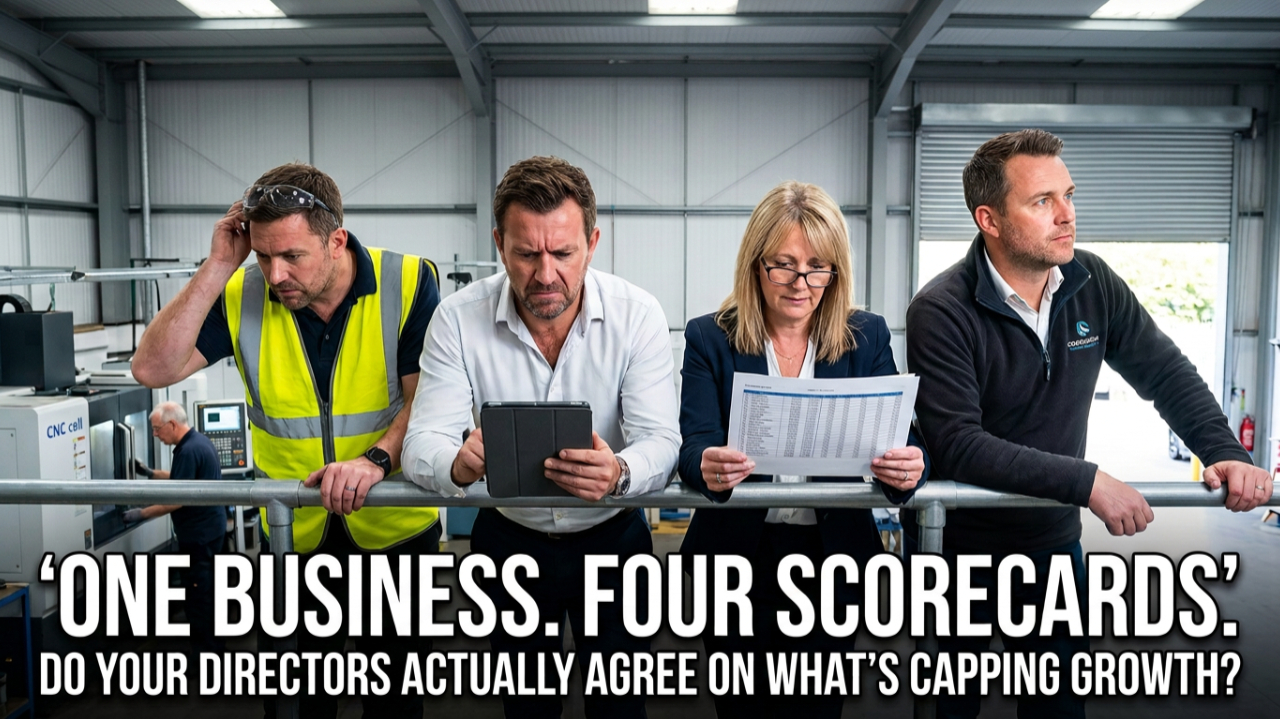
Strategic reset guidance consistently highlights unclear direction, weak alignment, and inconsistent decision-making as major warning signs for any scaling business. In engineering firms, this misalignment usually follows a very predictable and painful pattern.
Think about the different pressures your directors are under. The commercial team is pushing hard for growth because they are incentivised to bring in revenue and expand the client base. Meanwhile, your operations team is desperately trying to protect whatever production capacity they have left so they do not completely burn out the staff. And sitting right in the middle, the engineering team is just trying to reduce the endless amount of rework caused by rushing complex projects through the door.
Everyone is working incredibly hard, but different leaders are trying to solve entirely different problems.
I have sat in these management meetings, and they are exhausting. They produce a huge amount of passionate discussion but very few actual decisions. People talk around the operational issues for two hours, point fingers at other departments, and then go right back to their desks to do exactly what they were doing before.
The business completely lacks a shared view of what actually matters most this quarter.
Is it revenue growth? Is it margin protection? Is it quality control?
If the directors cannot agree on the main priority, how can you expect the rest of the company to know what to do?
Misalignment at the leadership level quickly becomes confusion everywhere else in the business. When your leaders are pulling in different directions, the company loses momentum and starts tearing itself apart from the inside.
Sign three: Sales, engineering and operations are out of sync
This section is probably going to feel very real to you, because it is usually the most painful part of the daily routine.
Research on siloed teams shows that disconnected functions massively increase execution risk, slow down delivery, and weaken outcomes on critical projects. For engineering firms, this is often the hidden cost of scale. When you were a team of twenty people, everyone knew what everyone else was doing. You could shout across the office to clarify a drawing. At fifty or a hundred people, that organic communication completely breaks down.
Suddenly you have situations where the sales team sells a complex project that the operations team did not help shape or price. The client is promised the world on a silver platter with an aggressive deadline. Then the engineers get hold of the specifications and discover serious technical delivery issues far too late in the process. They have to redesign parts of the solution on the fly just to make it work.
By the time the project finally reaches the factory floor, operations is already behind schedule and over budget before they have even started cutting metal.
And who gets the blame?
Operations feels blamed for failing to deliver on ridiculous promises made upstream by the sales team. Sales feels frustrated that operations cannot seem to deliver anything on time without complaining. Engineers feel ignored by everyone.
It creates a genuinely toxic culture.
The key message here is simple: when departments stop sharing context and stop collaborating on the front end of a project, the business loses speed, quality, and trust. You cannot run a scalable engineering firm if your internal departments are treating each other like rival companies.
Sign four: Delivery is becoming harder to control
Let us move from structural misalignment down to the actual operational symptoms on the floor.
If you read the latest project management commentary, the warning signs of a breaking operating model are always the same: missed deadlines, rising material costs, constant rework, quality control issues, and a steady increase in customer complaints. These are not isolated bad days or unlucky breaks. They usually point directly to broken process design or weak handovers between your teams.
You might find that your projects are technically successful but commercially disappointing.
Your engineers might build a beautiful, highly functional piece of equipment that solves the client problem perfectly. But if it took twice as long to design and required three rounds of expensive rework because the initial brief was wrong, it is a commercial failure.
Your teams look incredibly busy all the time, but the workflow just feels chaotic. Every single day feels like a scramble to find parts, chase suppliers, expedite shipping, or fix avoidable mistakes.
Perhaps the most telling symptom is how you deal with your clients.
Are you consistently meeting their expectations, or are you just managing their disappointment?
If your project managers are spending most of their week apologising to clients for slight delays or asking for just a little more time, your delivery engine is stuttering. Repeated delivery friction is often the clearest proof that your current operating model is no longer fit for your firm at its current scale.
What worked beautifully at five million turnover will absolutely break at fifteen million. The processes that got you here will not get you there.
Sign five: The business is stuck in firefighting mode
I want to zoom out a bit here and connect all these earlier signs into one overarching leadership problem.
Several sources on SME growth ceilings note that businesses can easily become trapped in a reactive mode. This is where owners and senior leaders spend almost all of their time solving urgent, immediate issues instead of actually shaping the future of the company.
Are you or your directors still far too involved in day-to-day decisions?
If a machine breaks down, a supplier is late, or a key client is unhappy, does it immediately escalate to the boardroom? That is a huge red flag.
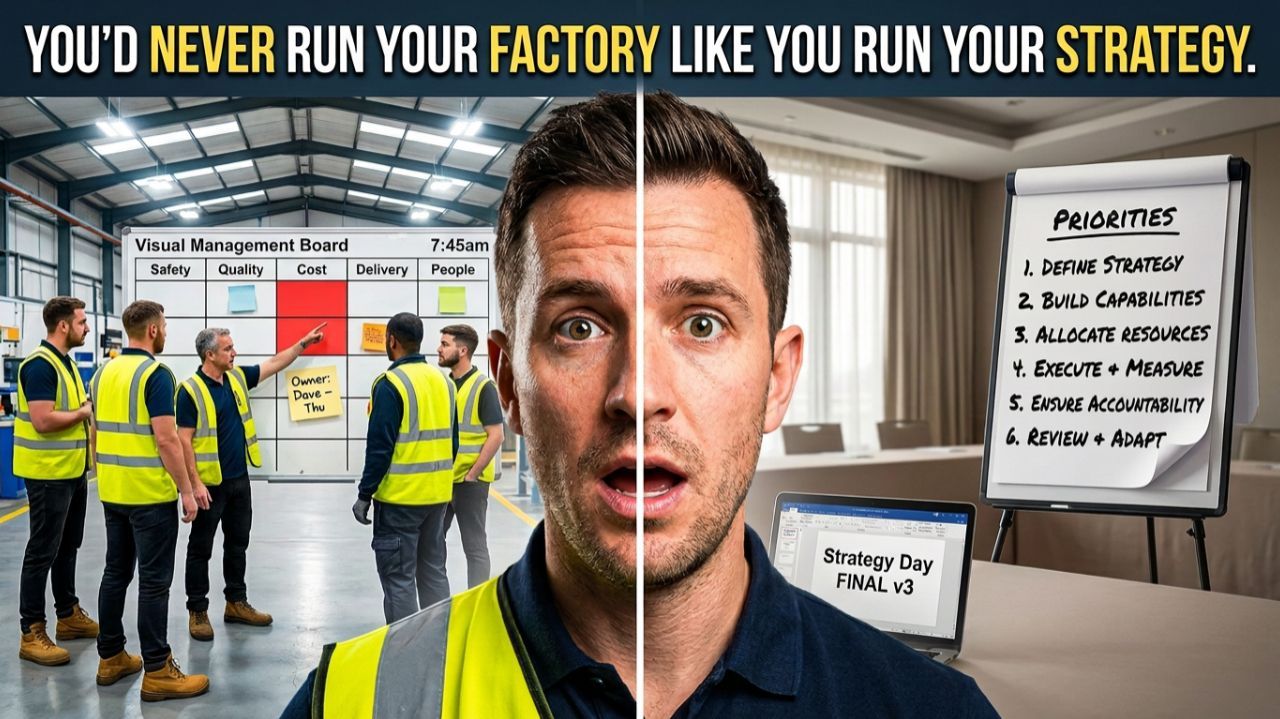
Strategy is talked about at the annual away day, but it is rarely translated into meaningful daily action. You have grand plans for expanding into new markets, upgrading your facilities, or launching new product lines, but you never seem to find the time to execute them because you are too busy putting out fires.
Growth starts to feel significantly harder despite more effort and more activity. You hire more people, but the workload does not feel any lighter. In fact, adding more people sometimes just seems to create more communication problems.
To be honest, this is the clearest sign that a reset is long overdue.
If the business cannot create space for its leaders to think, it simply cannot create a scalable future. You will remain trapped in a cycle of exhausting reactivity until you deliberately decide to change the rules of how your company operates.
You cannot lead a business if you are constantly trapped in the engine room trying to fix leaks.
What a strategic reset looks like
I do not want to just diagnose your problems and leave you with a sense of dread. Let us talk about the solution.
A strategic reset sounds like an intimidating corporate buzzword, but it really is not. It is not a full rebuild of your company. You do not need to fire everyone, scrap your software, and start from scratch. It is simply a deliberate realignment of focus, accountability, priorities, and your daily operating rhythm.
In a mid-sized engineering firm, a reset might mean sitting down and ruthlessly reviewing your margin profile. You need to look at the hard data and figure out which projects actually make money and which ones are just vanity revenue that drain your resources.
It means tightening up your project qualification process so your sales team stops bringing in bad work just to hit their targets. It means clarifying ownership so that when a problem arises, everyone knows exactly whose job it is to fix it without calling a massive two-hour meeting.
Practical reset actions are actually quite straightforward once you commit to making the time for them.
You might start by reconfirming your target markets and defining what your ideal work actually looks like. You should definitely review pricing and margin expectations by project type so you stop undercharging for complex engineering work.
You need to clearly define leadership roles and responsibilities so directors can finally step back from the daily grind and trust their teams. You must improve the handover process between sales, engineering, and delivery so projects flow smoothly instead of crashing into invisible walls.
And maybe most importantly, you need to set a clearer weekly or monthly performance cadence. You need simple metrics that tell you if you are winning or losing this week without waiting for the month-end accounts.
I know some people hear the word strategy and immediately worry about creating more paperwork. But a true reset should reassure you. It is entirely about restoring control and focus. It is about stripping away the noise, reducing the chaos, and making things simpler, not adding more bureaucracy to an already heavy system.
Conclusion: The business is telling you something
Let us bring all these five signs back together.
Shrinking margins despite rising revenue. Misaligned leadership teams pulling in different directions. Siloed departments that do not talk to each other. Chaotic delivery that relies on heroics instead of process. And a leadership team stuck in endless firefighting mode.
If you are nodding your head right now, I need you to understand something very important.
Your firm is not broken.
You have clearly built something incredibly valuable because clients are still buying from you and you are still growing. But you are operating with a strategy and an operating model that simply no longer matches your size, your complexity, or your future ambitions. The friction you feel every day is just the sound of a business outgrowing its container.
A strategic reset is the bridge between where you are and where you want to be. It is what allows a highly capable engineering business to move from feeling constantly busy and heavily pressured to feeling clear, controlled, and truly scalable.
You have to listen to what the daily friction is trying to tell you.
If these signs feel a little too familiar, your business probably does not need more effort from you or your team. You are already working as hard as you possibly can.
What your business actually needs is a much better direction.
If your engineering firm is growing in revenue but feeling heavier in execution, it may be time to reset the strategy before the strain becomes the story, check out our
Strategy SPRINT workshop.