Have you ever tried to find two consecutive days when all of your directors are free?
It's harder than it sounds. Your sales director has a customer visit in the North East that's been moved twice already. Your operations director has a customer audit, then a week of holiday that was booked in January. Your finance director can't do the end of the month, obviously, or the week the bank comes in. You've got a trade show. Somebody suggests a Friday and a Monday, and somebody else points out that isn't really two consecutive days, it's a weekend with a strategy session either side of it.
Six weeks later, you've finally got a date. Two days, everyone in the same room, phones mostly away.
I don't think most leadership teams appreciate how unusual that is. A survey of 2,000 UK small business owners and directors by Virgin Media O2 Business found that around one in five hadn't taken two consecutive days off in the previous six months. Not two days of strategy. Two days of anything that wasn't the business. So when you do manage to clear two days for the whole leadership team at once, you've just spent one of the scarcest things your business has.
Here's the question I'd want you to ask about it. What did those two days actually change?
We describe our Strategy SPRINT as a two-day circuit breaker, and I've come to think that's a more useful image than it first sounds. Think about what a circuit breaker actually does. When the load gets too heavy, it trips and cuts the current, which protects the circuit. That's all it does. It doesn't repair anything. If you flick it back on without changing the load or finding the fault, it'll trip again, maybe not today, but soon.
A lot of strategy days work exactly like that. They cut the current for two days, which genuinely helps. Then everyone goes back, flicks the switch, and carries on with the same load running through the same wiring. And a year later you're trying to find two consecutive days again, so you can have more or less the same conversation.
So this post is about what the two days have to rewire if they're going to be worth it. My answer, after a fair few years of sitting in these sessions, first as one of the directors in some fairly big industrial groups and more lately as the person holding the pen, is a bit different from the usual one. It isn't really the plan. It's attention. Where your leadership team's attention goes on an ordinary week, and whether that's any different afterwards.
The scarcest thing in your business isn't cash
Ask most manufacturers what their scarcest resource is and you'll hear cash, or skilled people, or capacity on one particular machine. All fair. But I think there's something scarcer, and it rarely gets managed at all.
It's the attention of four or five people.
Back in 1971, the economist Herbert Simon made a point that's aged remarkably well. He wrote that "a wealth of information creates a poverty of attention." He was talking about organisations long before email, dashboards and WhatsApp groups, but you'd struggle to describe a modern MD's week any better.
A couple of decades later, William Ocasio, a professor at North Western University, took the idea further in the Strategic Management Journal. His argument, roughly, was that what a firm actually does follows from how it channels and distributes the attention of its decision makers. Which issues reach them, through which meetings and reports, and what gets their focus as a result. Not the plan. The attention.
And then there's an idea I've always liked from Robert Simons and Antonio Dávila at Harvard. They suggested leaders should think about a "return on management": the productive energy released in the business, divided by the management time and attention that went into it. In other words, treat your attention like capital. Ask what return it's earning.
That sounds a bit lofty for a Tuesday in a factory office, so let's bring it down to earth.
When Michael Porter and Nitin Nohria tracked the time of 27 chief executives of large companies, in fifteen-minute blocks over three months, they found that strategy got about 21% of their working time. These were people with chiefs of staff, executive assistants and whole strategy teams, and strategy still got about a fifth of the week.
Your directors don't have any of that. The same Virgin Media O2 survey found UK small business directors spend around ten hours a week on tasks outside their core expertise, and three quarters said that on any given day they're acting as chief executive, HR manager, IT support and finance director all at once. Research by the Productivity Institute, working with Be the Business and the Behavioural Insights Team, found what you'd probably expect: SME leaders spend most of their time working in the business rather than on it, and the ones who'd benefit most from stepping back feel they have the least time to do it.
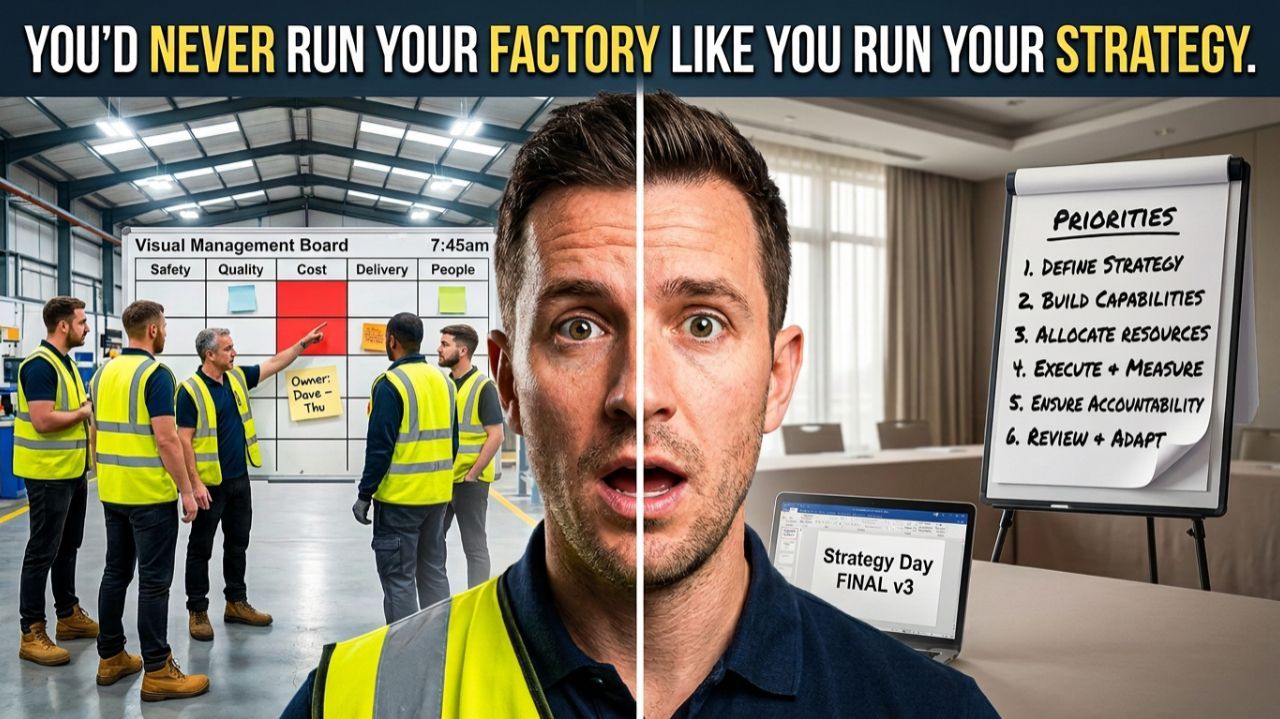
So here's the uncomfortable conclusion, and I'll admit it took me a while to accept it myself. Your strategy isn't what's written in the plan. Your strategy is whatever your directors actually pay attention to on an ordinary Wednesday. If the plan says "grow defence work" and nobody's diary has changed, the real strategy is still whatever it was before.
Why most strategy days reset the breaker without changing the load
If attention is the real currency, then most strategy days have a design problem. They add things, but they never take anything away.
Think about what usually comes out of two days away. New priorities. New targets. Maybe a new market to go after, a new product to develop, a project to fix pricing. All of it is extra content, landing on people whose weeks were already full on the Friday before the session. Very little of it says what any of those people will stop looking at, which meetings they'll stop sitting in, or which reports they'll stop reading at six in the morning.
There's some fascinating research on this, done on a big scale. A team of economists, Oriana Bandiera, Andrea Prat, Stephen Hansen and Raffaella Sadun, tracked how 1,114 chief executives spent a working week, across six countries including the UK. They found two broad styles. Some spent most of their time with production staff and in one-to-one meetings. Others spent more of it with senior colleagues, in meetings that brought several functions together. That second group was linked with noticeably higher productivity, although the effect took a few years to show and depended a lot on whether the style suited the firm.
I wouldn't read too much into the labels. Plenty of brilliant MDs in businesses your size need to be on the shop floor. But the bigger point stuck with me. How senior people spend their time isn't a side issue. It shows up in the numbers, slowly, over years. Which means the meetings you sit in are, in a very real sense, your strategy.
I remember a wire harness and cable assembly business in the North West, around £7m turnover. Their strategy session was genuinely good. They decided, quite sensibly, to grow their rail and defence work, where their quality systems gave them a real edge, and to rely less on a handful of industrial customers who bought on price.
Six months later, the quoting team was drowning. Enquiries were coming in from everywhere, rail and defence included, but also small batch work from all sorts of people who'd found them online. Nobody had told the sales team what not to chase. So they chased all of it, the estimator worked late every night, and the rail quotes went out in the same queue as everything else. The strategy had added a target without changing anyone's attention. The breaker had been reset with exactly the same load.
Four things the two days have to rewire
So what should two days actually produce, if not just a list of priorities?
The most useful framework I've found for this comes from Robert Simons again, in his book Levers of Control, published back in 1995. It was written about much bigger organisations, but I think it translates surprisingly well to a £3m to £25m manufacturer. In plain English, it suggests leaders steer a business through four things. Here's how I'd turn them into four outputs from a strategy session.
1. One sentence anyone could repeat
Simons calls this the belief system: the direction and values that senior people state clearly and then visibly live by.
For a business your size, I don't mean a vision statement for the reception wall. I mean one sentence that your estimator, your production supervisor and your newest sales hire could repeat in their own words, and that would actually help them make a decision. "We're becoming the go to supplier for rail and defence harnesses where traceability matters more than price." You could argue with that. Good. It means something.
If the sentence could belong to any manufacturer in the country, it isn't doing its job. Try it on a few of your supervisors in the week after the session and see if they can say it back without reading it.
2. A boundary list
This is the one most strategy days miss, and I think it's the most powerful of the four.
Simons describes boundary systems as the things that tell people what the company won't do, so they don't spend time and energy on opportunities it's never going to pursue. ICAEW, in its guide to his work, gives a couple of lovely examples. Microsoft once ruled out making hardware or running telephone networks. IBM famously turned down an idea from one of its own salesmen, Ross Perot, who went off and built a very large business called EDS on it. Boundaries cut both ways, so they need writing carefully and reviewing now and again. But without them, everyone's attention leaks into everything.
For a manufacturer, a boundary list might say: we don't quote batches below a certain value. We don't quote outside these three sectors without the MD's say so. We don't take on new product introduction work with less than a set lead time. We won't chase that big retailer again, however tempting the volumes look.
Back to the cable assembly business. When they eventually wrote a boundary list, it was four lines long. Minimum batch value. Rail, defence and two named industrial customers only. No free sampling outside those sectors. A polite standard reply for everything else. Within a couple of months, the quoting queue was half the length, and the estimator stopped working until nine every night. Funnily enough, the win rate on rail work went up too, mostly because those quotes were going out faster and with more care.
3. One uncertainty you'll work on personally
Simons calls this an interactive control system, and it's the cleverest idea in the framework, I think.
The point is that every strategy rests on at least one big uncertainty, something that could sink it if you've got it wrong. Rather than trying to watch everything, the top team singles out one issue for special attention. It becomes a standing item at the top of the leadership agenda, it gets talked about face to face rather than in a report, and people keep challenging the data, the assumptions and the plans around it. ICAEW's example is Pepsi using market share against Coke as its single focus for years.
So the third output of your two days is a question, not an answer. What's the one thing that, if we're wrong about it, makes the whole plan wobble?
I worked with a pump refurbishment business in Scotland whose whole growth plan leaned on water utility framework work during the current five-year industry investment period, the one the sector calls AMP8. The opportunity was real. But the honest uncertainty was whether the frameworks would actually release work at the volumes and in the timescales, everyone was talking about. So "what are the frameworks actually releasing, and what are we hearing?" became the first item at every leadership meeting. Not a slide. A conversation, with the people who'd been on the phone to the utilities that month. When the volumes slipped in one region, they knew within weeks rather than at the year end, and they moved two engineers onto industrial service work before the gap showed in the accounts.
That's what attention on the right uncertainty buys you. Not certainty. Time.
4. What you'll hand over to the numbers
The fourth lever is what Simons calls diagnostic controls. These are the measures that run by exception: you set a target and a tolerance, and you only look closely when something drifts outside it. Their whole purpose is to free senior people from watching everything all the time.
Here's where a lot of owner managed businesses quietly lose hours every week. The MD of a South Wales industrial coatings business I knew read every daily output report himself, at six every morning, before anyone else was in. Every line, every day, for years. When we talked about it, he admitted that he acted on maybe one in twenty of them. The rest he just needed to know.
At their strategy session, he handed the daily reports to his operations director, with agreed tolerances on throughput, rework and on time delivery. Anything outside those, he'd hear about the same day. Anything inside, he wouldn't. It freed up about five hours of his week, which he spent, quite deliberately, with the two customers whose decisions would shape the next three years.
One word of caution. Simons also warned that if the targets are unrealistic, people tend to game them. So the tolerances need to be honest ones, set with the person who's going to own them, not handed down.
Open the diaries before you close the session
So you've got your sentence, your boundary list, your one uncertainty and your measures handed over. There's one more step, and to be honest it's the one I'd least want you to skip.
In the last hour of the two days, open the diaries. Literally. Laptops on the table, calendars on screen.
Each director makes three changes there and then, while everyone's still in the room.
One meeting they'll stop attending. Most of us sit in at least one recurring meeting out of habit. Porter and Nohria found that even big company chief executives admitted many of their one-hour meetings could have been thirty or even fifteen minutes. Your directors will have their own version.
One standing slot for the new focus. If the uncertainty you picked is going to be the first item at every leadership meeting, it needs to be in the diary now, with the right people invited, not "sorted out next week."
Where the freed hours go. If the MD is handing over the morning reports, where do those five hours actually land? Write it in. Attention that isn't given a new home has a habit of drifting straight back to where it came from.
It feels a bit odd the first time you do it. Strategy days aren't usually supposed to end with people moving meetings around in Outlook. But this is where the circuit gets rewired rather than just reset. A plan that hasn't changed anyone's diary is, I'd say, mostly a hope.
Then, about a month later, try a simple version of Simons and Dávila's return on management. Pull up each director's diary for the four weeks after the session and compare it with the four weeks before. Has the new focus actually got time? Did the boundary list free any up? Is the standing item still the first item, or has it slipped to "any other business"? You don't need a formula. You'll see the answer.
The strategy is in your diary
Two consecutive days with your whole leadership team is rare and expensive, so it's worth being clear about what they're for.
They're a circuit breaker. They cut the current, give everyone room to think, and protect the business from carrying on at full load without a pause. But a breaker doesn't fix anything by itself. If the same load goes back through the same wiring, it'll trip again.
What fixes it is changing where attention goes. That means one sentence of direction that people can actually repeat. A boundary list, so the business stops spending energy on work it was never going to pursue. One big uncertainty the leadership team works on personally, face to face, every time it meets. Measures handed over to run by exception, so senior time comes back. And, before anyone leaves the room, diaries opened and changed.
If you'd like help with that, it's very much the spirit our Strategy SPRINT is built in. It's a two-day operational circuit breaker for UK manufacturing and engineering firms turning over £3m to £25m, built around the three things that usually compete for your leadership team's attention: sales pipeline, production capacity and cash flow. Two weeks beforehand, each of your key directors completes a ten-minute digital diagnostic, so we can see the misalignments, the friction between departments and the hidden bottlenecks before anyone walks into the room. Day one takes an honest, unvarnished look at your sales strategy, operations and profitability, challenges a few comfort zones safely, and shapes a unified 12-month tactical plan. Day two isolates exactly what's choking your growth right now, agrees your Big 3 priorities, and locks down a named, measurable 90-day execution plan.
It's from £3,000 plus VAT, and because its intensive, places are limited. You can read more and
book your Strategy SPRINT here. Or, if you'd rather talk it through first,
book a free, no pressure strategy call.
And if you do nothing else, try this before your next session. Print off your own diary for the last four weeks and highlight every hour that went on the thing you'd say matters most to the business's future. It's a slightly sobering exercise. It's also, I think, the most honest strategy document you've got.
Because the strategy day is not the strategy. Your diary is.