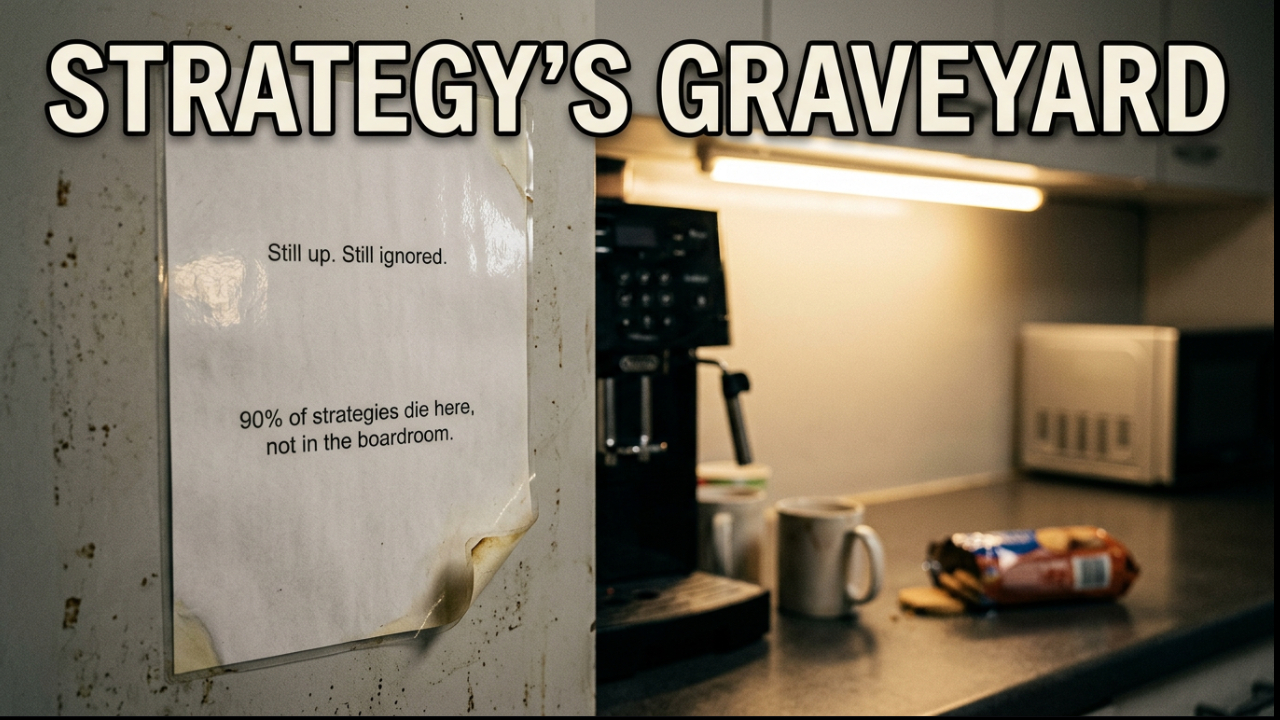
There are only really four places a growth number gets said out loud.
There's the board meeting, where it gets nodded through somewhere between the finance update and AOB, and everyone treats it as settled the second the chair moves on. There's the bank, where the number sits inside a facility renewal or a fresh borrowing request, and the relationship manager is mostly checking whether the market opportunity behind it stacks up. There's the one to one with the group MD, the informal chat where you commit to a figure that quietly becomes next year's plan the moment you're both back at your desks. And there's the kitchen table, the family business version, where the next generation or the founder says something like we're going to double this, almost as a statement of who they are rather than a plan with a method attached.
Four different rooms. Four different audiences. One thing missing from every single one of them.
Nobody in any of those conversations asks whether the business, as it's actually built today, can carry a number that size.
Not the market opportunity. That bit usually gets tested properly enough, the pipeline, the addressable market, the gaps a competitor has left open. It's the structure underneath it that gets skipped. Who decides what once you're a third bigger. Who tells who, and how quickly. Whether the three people currently doing the work of five can somehow become the people running a business that's grown by forty percent, without anyone quite deciding that's what needs to happen.
Nobody signs off a growth number and signs off the redesign it requires in the same meeting. The plan gets treated as real the moment it's said out loud. The capacity to deliver it gets quietly assumed. And that gap lands on you. You're the MD who's already said the number to someone who's going to hold you to it, and you're the one now doing the arithmetic, usually alone, on how it actually gets made real.
I've sat on both sides of that conversation. As the MD who's said the number in a group meeting and then driven home doing sums in my head about how on earth it happens. And later, on the group side, in the room where someone else says their number, nodding along, while quietly wondering whether they've actually thought about who does what differently from Monday morning.
Why none of the four rooms asks the real question
It's worth sitting with this for a second, because it isn't laziness or oversight. Each of those four rooms has its own reason for staying on the surface.
The board is looking at strategy and risk at a level above the org chart. Their job is largely to test whether the number is ambitious enough and whether it's credible against the market, not to ask whether Sandra in operations can now approve purchase orders that used to need you personally. The bank is assessing repayment risk against revenue and margin, not against whether your reporting lines can tell you in week two of a bad month that it's a bad month. The group MD conversation is often the most informal of the four, which is exactly why it's the easiest one to leave unexamined. You say a number that feels right, they write it down, and it becomes real through repetition rather than scrutiny. And the kitchen table version isn't really a planning conversation at all. It's closer to a statement of ambition and asking your own family whether the business can structurally carry that ambition feels, frankly, like a strange thing to do over dinner.
There's real money sitting behind that dinner table conversation too, more than most people would guess. Research commissioned by Investec Wealth and Investment put the UK family business sector at something like five hundred and ninety-five billion pounds, employing around thirteen point nine million people, and found that roughly a third of the larger family businesses in that research were already weighing a sale to outside investors as part of how they planned to exit. Some of that is succession fatigue, understandably. But some of it, I'd guess, is a quiet recognition that growing past a certain point needs structure and discipline brought in alongside the capital, because getting there organically, with the systems currently in place, is a slower and messier road than the kitchen table conversation makes it sound.
It's a similar story once private equity is involved on the group side. Growth targets attached to that kind of investment can be genuinely aggressive, sometimes something like fifty percent revenue growth inside two years, and that number gets agreed by a room full of very capable people who are excellent at assessing markets and considerably less focused on whether the operating model underneath the business they've just backed can physically carry it.
I think there's something else going on too, which is that structure is genuinely hard to talk about in the same breath as a number. A number is clean. Thirty percent growth, a new facility, a second site. Structure is messy and slow and involves telling someone their job is changing, or that a decision they've always made now needs to go through someone else. Nobody wants to bring that into a room where the mood is optimistic. So it gets parked, silently, as something to sort out later, once the number is already locked in.
The trouble is that later usually arrives as a crisis rather than a planning session.
Capacity was sized for the business you were
Here's the bit that catches people out first, because it's the most physical. Capacity, in the plain sense of hours in the day and hands on tools, was built for the business you had eighteen months ago, not the one you've just promised a bank or a board you'll become.
Enginuity's SME Snapshot for March 2026, drawing on more than 250 engineering and manufacturing SMEs across the UK, found that around 76 percent of respondents were operating below full capacity, even while confidence about growth held up reasonably well. Read that carefully. It's not that demand is missing. It's that the inputs to deliver against demand, people, skills, sometimes plain hours, are the constraint. A growth number assumes those inputs will simply stretch to fit. They rarely do, not without a plan.
Research into UK SME workforce pressures for 2026 points to something similar from a different angle. Managers in smaller manufacturing businesses are routinely leading a team while still doing hands on operational work themselves, and leadership and management capability gaps are widening precisely because high performers get promoted into management without ever being given the training or the time to actually manage. That's not a criticism of anyone. It's what happens when growth gets committed to without a parallel decision about who's freed up to lead rather than do.
I've watched this play out in more than one group owned business, and it follows a pattern that's almost boring in its consistency. The number gets agreed. Everyone's genuinely pleased. Six months in, you're the same handful of people who ran the business at its old size, except now you're also running it at the new one, later into the evening, with a shorter temper than usual. Nobody decided that was the plan. It just happened, because the capacity conversation never got its own meeting.
There's a slower version of the same capacity problem running underneath all of this too. Around twenty one percent of the UK manufacturing workforce is currently aged fifty five or over, heading toward retirement across the next decade, and the pipeline replacing them hasn't kept pace. So the capacity question isn't only about adding people fast enough to match growth. In a lot of businesses, it's about the base you're building on quietly eroding at the same time, which makes committing to a bigger number without a capacity plan riskier than it looks on paper. It's not a coincidence that a recent survey of manufacturing leaders found talent scarcity, rather than demand, now seen as the single biggest constraint on growth looking out toward the mid 2030s, with well over half naming it their top concern. That's not a today problem you can flex around for a quarter. That's structural, and it's exactly the kind of thing a growth number tends to skip straight past.
The honest question, and it's an uncomfortable one to ask yourself the same week you've agreed a growth number, is this. If revenue goes up by a third, does headcount, skill mix, or hours need to change to match, and if so, when does that hiring or restructuring actually happen relative to the growth itself. Before, ideally. In practice, almost always after, once the strain is already visible to the people living inside it.
Decision rights don't grow just because revenue does
This is the one that took me longest to properly understand, and I think it's the one that quietly does the most damage.
When your business was smaller, it was completely normal, sensible even, for one person, probably you, to make most of the calls. Pricing exceptions, which supplier gets the benefit of the doubt this month, whether a customer's late payment gets chased hard or gently. At that size, you holding all of that wasn't a flaw. It was efficient. There wasn't enough volume of decisions to justify spreading them out, and you had the full picture in your head anyway.
Growth breaks that quietly rather than loudly. The volume of decisions goes up roughly in line with revenue, but the number of people trusted to make them doesn't, because nobody explicitly decided to change that. So you go from making something like forty decisions a week to making a hundred and twenty, still personally, because the habit never got interrupted long enough for anyone, including you, to ask whether it should be.
I've watched this from the group side too, which gives you a slightly different view of it. You start to notice a pattern where the businesses that plateau just after a growth commitment aren't the ones with a worse product or a weaker market. They're the ones where every meaningful decision still routes through one person, and that person has simply run out of hours to route them through. Practitioners who work specifically with owner led UK manufacturers describe this same pattern from the inside, businesses that are good at what they do, with strong order books and real reputations, that still feel harder to run than they should, precisely because decision making sits with too few people and growth exposes that rather than curing it.
The fix isn't complicated to describe, even though it's genuinely uncomfortable to do. It means naming, in writing, which decisions someone other than you can now make without asking. Not eventually. Before the growth arrives, ideally at the same time the number gets agreed, because a hundred and twenty decisions a week doesn't wait politely for a quieter month to get sorted.
Reporting lines built for a business half this size
The fourth piece is the one that tends to surface last, because it doesn't announce itself the way a missed deadline or an overworked manager does. It shows up as a nasty surprise at a board meeting, or a call from the bank asking why the numbers you're seeing look different to the ones they're seeing.
Reporting lines are just information flowing upward and outward fast enough for someone to act on it. In a smaller business, that flow is informal and it works fine, because the MD walks the floor, hears things directly, and has a feel for whether the month is going well long before any report confirms it. That instinct doesn't scale. Once you've committed a number to a board, a bank, or a group MD, you're now accountable to people who aren't walking the floor with you, and they need something more reliable than your gut telling you things feel about right.
This is where the gap tends to show up most painfully, because it's invisible right up until the moment it isn't. You commit a number, genuinely believing it, and then three months later, at the worst possible moment, you find out that the information you needed to know you were off track simply wasn't flowing to you in time to do anything about it. Not because anyone hid it. Because the reporting cadence was built for a business half this size, where a monthly chat covered everything that mattered, and nobody rebuilt it for a business now accountable to people outside the building.
I remember one conversation on the group side particularly clearly. An MD had committed to a strong number, genuinely believed in it, and when I asked how they'd know by month three if they were drifting off track, there was a pause that told me most of the answer before the words did. The information existed somewhere, in an invoicing system, in a production log, in someone's head on the shop floor. It just wasn't flowing anywhere useful, fast enough, to the one person now personally on the hook for the number.
Sitting on the group side, this is the question I found myself asking most often, and it's worth asking yourself now. How do you know, right now, whether you're on track, and how would you know if you weren't. More often than I'd like, the answer I got back was some version of I'd probably find out at the board meeting. That's not a reporting system. That's hoping the timing works out.
Committing to the structure in the same breath as the number
So what does actually closing this gap look like, practically, rather than as a vague resolution to be more organised.
It means treating the structural conversation as part of the same sign off as the growth number, not a follow up task for whenever things calm down. Concretely, that's three things happening alongside the number itself, not after it.
First, a capacity plan that says explicitly what has to change in headcount, skills, or hours to deliver the number, and roughly when, rather than assuming the existing team will simply absorb it. Second, a short, honest list of which decisions move away from the MD and to whom, written down somewhere more durable than a conversation, because a decision right nobody remembers agreeing to isn't really a decision right at all. Third, a reporting cadence rebuilt for the business you're committing to become, not the one you currently are, so that being off track shows up in week three rather than at the next board meeting.
It's also worth treating this as something you revisit at real moments in the business, not just once a year on a fixed date. Doubling headcount, opening a second site, landing a customer who's suddenly a third of your revenue, these are the points where the structure that worked yesterday quietly stops fitting, whether or not anyone's said a growth number out loud again.
None of this is glamorous. It won't feel as satisfying as the moment you say the number out loud and the room nods. But it's the difference between a plan that's real and a plan that's a hope with a percentage attached to it.
The number was always the easy part
Here's what I keep coming back to, having sat in both seats. Saying the number is the easy part. It takes one sentence and a bit of nerve. Building the thing that actually carries it takes longer, it's less exciting to talk about, and it rarely happens unless someone deliberately makes it happen, because the four rooms where the number gets committed will never ask for it on your behalf.
If you've recently said a growth number out loud, in a boardroom, to a bank, to a group MD, or across your own kitchen table, it's worth doing the honest version of the audit before the pressure of delivering it does it for you. Where does capacity actually need to change. Which decisions genuinely need to move off your desk. And do you actually know, today, whether you're on track, or are you just hoping you'll find out in time.
The businesses I've seen handle growth well aren't the ones with the boldest numbers. They're the ones who treated the structure as part of the commitment, not an afterthought to it. That's not a cleverer plan. It's just a more honest one.
If reading this left you quietly doing the arithmetic on your own business, that's worth paying attention to. Knowing where the gap sits, capacity, decision rights, or reporting lines, is useful on its own. Actually closing it, properly, with someone who isn't buried in the day to day of your business, is what turns a growth number from a hope into a plan. That's what our Strategy SPRINT workshop is for. It's a short, focused working session where we map the number you've committed to against the structure you've actually got today, find out exactly where it won't hold, and leave you with a real plan for capacity, decision rights, and reporting, not just a longer list of things to worry about. You can find out more and book a place on the
Strategy SPRINT workshop.