You know the day. Everyone's in the meeting room above the factory floor, or maybe you've splashed out on a hotel off the motorway for a change of scenery. There's coffee, a flipchart and a genuine sense that this time it's different. You agree three big priorities. Someone takes photos of the whiteboard. You drive home feeling lighter than you have in months.
Then Monday happens.
A key customer rings about a late order. A CNC machine throws a fault on second shift. Your best setter hands in his notice. By Wednesday the plan is still in your head, sort of. By the end of week two it's a slide deck on the shared drive. And by week three? Honestly, most people can't remember where the whiteboard photos went.
I've watched this happen more times than I'd like to admit. I've sat in those rooms, and I've been the person who said "right, let's make sure we keep this going" and then didn't. It's not a nice feeling. You start to wonder whether your team really cares, or whether you do.
Here's what I've come to believe after a lot of years working with UK manufacturers somewhere between £3m and £25m in turnover. The plan almost never fails because people stop caring. It fails because nothing was built to carry it. There's no rhythm, no regular moment where the plan gets picked up, looked at and moved forward. The production meeting happens every morning without fail. The plan meeting happens when someone remembers.
So this isn't really a post about commitment. It's about cadence. And if you get the cadence right, I think you'll find the commitment was there all along.
Let's dig into why week three is the danger zone, why "try harder" doesn't work, and what a simple rhythm looks like in a business your size.
What actually happens in week three
It helps to see the pattern laid out, because once you spot it, you can't unsee it.
Week one is launch energy. Everyone's fresh from the planning session. People mention the priorities in passing. Your production manager might even start on the first action before the deadline. It feels like momentum, and in a way it is. But it's borrowed momentum. It's coming from the event, not from any system.
Week two is the first collision. The day job pushes back. It always does. A supplier lets you down on steel, or a big order lands early, or there's an audit you'd forgotten about. None of this is unusual. It's just manufacturing. But every hour spent firefighting is an hour taken from the plan, and nobody's really keeping score.
Week three is the quiet miss. This is the bit that matters. Somewhere in week three, the first check in that was supposed to happen just doesn't. Nobody cancels it. It simply slides. Maybe it was never in the diary in the first place. Maybe it was, but the MD was out seeing a customer and nobody felt they could run it without him. Either way, the plan has now gone two or three weeks without anyone formally picking it up. And a plan that nobody's touched for three weeks starts to feel optional.
That's the moment it dies. Not with a bang. Just with a shrug.
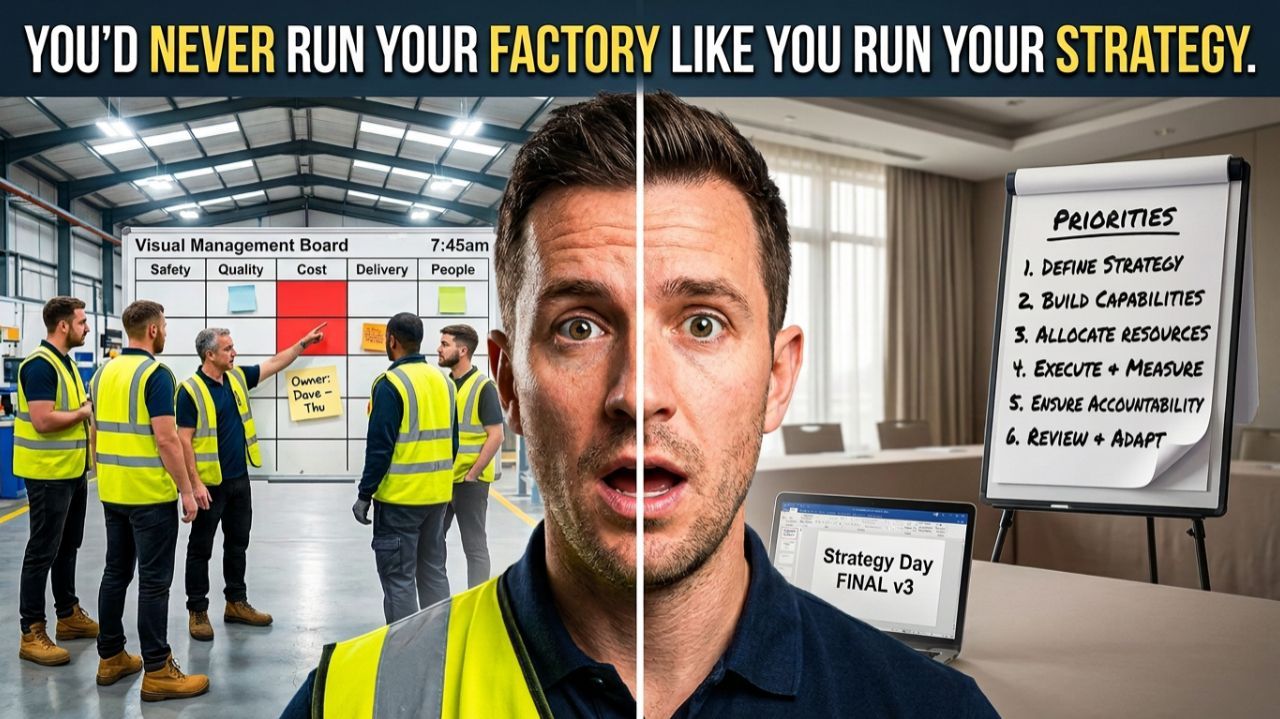
Why does this happen so reliably? I think it comes down to rhythm. Your factory already runs on rhythms. There's the morning production meeting, the weekly schedule, the monthly management accounts, the stocktake. Those things happen because they're built into the week. They don't rely on anyone feeling motivated. Your plan, on the other hand, usually has no rhythm at all. It's an event that happened once, with a vague intention to "review progress regularly".
When something with a rhythm meets something without one, the rhythm wins. Every time.
To be honest, the current climate makes this worse. Make UK's latest Manufacturing Outlook, published in September 2026, found that while orders and confidence have picked up, hiring intentions have weakened sharply because employment, energy and input costs are still biting. Plenty of firms are waiting for more certainty before they commit to growth plans. In practice, that means the same small group of people is running the factory and trying to improve it. Your operations director probably isn't getting a deputy this year. Your finance lead is already stretched. There's no programme office waiting in the wings.
I remember working with a precision engineering firm in the Midlands, about £12m turnover, with a really sharp operations team. They built a genuinely good plan to cut lead times. Clear, sensible, properly costed. Then they had a run of late deliveries to their biggest customer, and for three weeks every senior person was either on the phone or on the shop floor. When things calmed down, the lead time plan was still there, perfectly intact. But nobody picked it back up. It just felt like old news. Nobody decided to abandon it. It simply never got a second wind.
That's what I mean by week three. It isn't a failure of intelligence or effort. It's a predictable gap between the energy of launch and the point where a new routine can run on its own.
It was never a commitment problem
When a plan stalls, the instinct is to look for someone who didn't care enough. You might blame the team for a lack of buy in. You might quietly blame yourself for not pushing hard enough. Then the fix you reach for is more motivation: a rousing email, a bigger launch next time, maybe a consultant to rally the troops.
I get it. I've done it. But I don't think it works, and the research backs that up.
Take Donald Sull's work at MIT Sloan, published in Harvard Business Review. His team surveyed thousands of managers across hundreds of companies and asked them to name their company's top five priorities. Only 55% of middle managers could name even one. One. And here's the twist. Nearly nine out of ten managers said their leaders communicated the strategy often enough. So it wasn't that nobody talked about the plan. It was that the plan never became something people worked on week to week. Sull also found managers were about four times more likely to blame having too many priorities than to blame unclear communication.
That should feel familiar. How many priorities came out of your last planning day? Be honest. If it was more than three, you were probably in trouble before week one had finished.
Bain & Company looked at it from another angle. In a study of 426 companies going through major strategic change, only 12% fully delivered what they set out to achieve. Executives reckoned they lost about 40% of their strategy's potential value to breakdowns in execution. Forty percent. That's not a rounding error. That's a lot of good thinking evaporating somewhere between the meeting room and the shop floor.
Now, you might be thinking those are big corporate numbers, and you run a £9m fabrication business, not a FTSE company. Fair enough. But the UK evidence is, if anything, sharper for firms like yours. ONS data on British manufacturers found that businesses in the top half for structured management practices were about 38% more productive than those in the bottom half. And the practices most closely linked to productivity weren't clever strategy tools. They were the regular, slightly boring ones: performance reviews, dealing with underperformance, training. Things that happen on a rhythm.
The LSE's Centre for Economic Performance has gone further, suggesting management practices could explain around half of the productivity gap between the UK and the US, with smaller firms generally scoring lower. That's not a commitment gap. It's a systems gap.
I once worked with an MD who was convinced his senior team simply didn't care about growth. He'd say it to me over coffee, genuinely frustrated. "They nod along on the day and then nothing happens." So I asked his team, separately, what the three priorities from the last planning session were. Not one of them could name all three. Two of them named things that weren't even on the list. When we talked it through, it wasn't apathy at all. They'd had no regular moment to look at the plan since the day it was written. They cared. They just couldn't see it anymore.
That conversation changed how I think about all of this. If your people can't see the plan in their normal working week, they can't work on it. And no amount of passion at the launch will fix that.
What carries a plan: building your cadence
So if commitment isn't the fix, what is? In my experience it's a simple, repeatable rhythm that gives the plan a regular place in the week. Not a big system. Not new software. Just a heartbeat.
I'd suggest three beats.
The weekly huddle. Thirty minutes, same day, same time, same room. Maybe Tuesday at 8.30, after the production meeting but before the day gets away from you. The only agenda is the plan. What did we commit to last week? Did it happen? What's blocking us? What will each of us do before next Tuesday? That's it. No slide decks. No long updates. If something needs a proper discussion, you park it and book a separate slot.
It sounds almost too simple. That's sort of the point. A meeting that's light enough to survive a bad week is worth far more than an impressive one that gets cancelled the moment a customer complains.
The monthly review. Once a month you step back a bit further. Are the measures moving? Are the three priorities still the right three? Is anyone overloaded? This is where you look at the numbers properly, ideally alongside your management accounts so it doesn't feel like yet another meeting. Ninety minutes is usually plenty.
The quarterly reset. Every three months you ask the bigger questions. What have we finished? What should we stop? What's changed in the market? Given how quickly things have shifted for UK manufacturers over the past year, with costs, demand and policy all moving at once, a quarterly reset isn't a luxury. It's how you stop a sensible plan from quietly becoming an outdated one.
Around those three beats, a few things make a huge difference.
Every priority needs one named owner. Not a department. Not "the senior team". A person. When something's owned by everyone, it's owned by no one, and in a business your size there's nowhere for that to hide for long.
The plan should fit on one page. If it doesn't fit on a single side of A4, it's probably too complicated to carry through a busy quarter. I've seen beautifully designed 40-page plans that nobody opened after the first week, and scruffy one-page plans that drove real change for years.
Make progress visible. A whiteboard in the office, a simple screen by the production office, even a printed sheet updated every Tuesday. When people walk past the plan every day, it stays alive in their heads. When it lives in a folder, it's already half forgotten.
Then there's a trick from behavioural science that I really like. Psychologists Peter Gollwitzer and Paschal Sheeran reviewed 94 studies on what they call implementation intentions, which are basically if then plans. Instead of saying "we'll review the plan weekly", you decide in advance exactly what happens when something gets in the way. If the MD is away on Tuesday, then the ops director runs the huddle. If there's a customer crisis on Tuesday morning, then the huddle moves to 3pm the same day, not next week. Their analysis found these plans had a medium to large effect on whether people actually reached their goals. It works because you've removed the decision at the exact moment you're most likely to drop the ball.
And here's why patience matters. Researchers at UCL, led by Phillippa Lally, followed people trying to build a new daily habit. The typical person took around 66 days before the behaviour felt automatic, and some took far longer. Week three sits at roughly day 15 to day 21. That's nowhere near the point where your new rhythm runs on autopilot.
It's the trough, where the launch buzz has gone and the habit hasn't formed yet. If you know that going in, you can plan for it instead of being surprised by it.
The encouraging bit? Lally's team found that missing a single day didn't wreck the process. What killed it was being wildly inconsistent. Which brings me neatly onto how you make this work when you're short on time and people.
Making it work in a £3m to £25m business
Here's the thing about a business turning over somewhere between £3m and £25m. You're big enough to have real complexity, with multiple shifts, a few hundred product lines, maybe a couple of sites. But you're rarely big enough to have people whose whole job is driving change. Your leadership team does the day job and the improvement work. So the rhythm has to be light, stubborn and hard to kill.
A few things I'd suggest, based on what I've seen work.
Cap it at three priorities. I know it's tempting to include everything. The ERP upgrade, the new product range, the recruitment push, the energy project, the lean programme. But remember Sull's finding about too many priorities. Three is about the limit for a lean team to genuinely move forward at the same time. Everything else goes on a "next" list, and you pull from it when something's finished.
Protect the slot like a customer audit. You'd never cancel a customer audit because the week got busy. You'd move heaven and earth to be ready. Treat your weekly huddle with the same respect. If it moves, it moves within the same week, never off the calendar altogether.
The MD has to turn up. This one's a bit uncomfortable. If you're the MD or owner, your attendance is the single strongest signal of whether the plan matters. Skip it twice and everyone notices. Be there every week, even for ten minutes, and the message is clear without you saying a word.
Use the missed week rule. One missed huddle is fine. Life happens, and the habit research says one slip won't undo your progress. Two missed in a row is a warning sign. If that happens, the very next thing you do is book the next one and say out loud, to the team, that you've drifted. Naming it takes the sting out and resets the rhythm.
Keep the tools boring. You don't need fancy software. A shared spreadsheet, a whiteboard or a single page on your existing system will do. The tool should never be the reason the meeting can't happen.
I'll tell you about one business that really stuck with me. A family-owned packaging manufacturer, about £18m turnover, had been through three restructures in five years. Directors came and went. Plans came and went too. Then the production director, who'd been there over 20 years, started a 20-minute stand up every Tuesday at 8am. Three priorities, a whiteboard, a marker pen. Nothing else. People were sceptical at first, and honestly a bit dismissive. But he never missed it. Not once in the first six months. A couple of years later that little Tuesday huddle had outlasted a new MD, a site move and a nasty supply crunch. It was the most durable thing in the business. And the plans actually got delivered.
He didn't have more commitment than anyone else. He just had a rhythm that wouldn't die.
Conclusion: give your next plan a heartbeat
Let's pull this together.
Week three is when good plans tend to die. Not because your team stopped caring, and not because the plan was wrong. It's because the launch energy has faded, the day job has pushed back, and there's no regular moment where anyone picks the plan up again. The production meeting has a rhythm. Your plan doesn't. So the production meeting wins.
The evidence is pretty consistent on this. Most strategies lose a big chunk of their value in execution. Most managers can't reliably name their company's priorities, even when leaders think they've explained them well. And in British manufacturing, the firms with structured, regular management habits are markedly more productive than those without. None of that points to a commitment problem. All of it points to cadence.
So here's my suggestion, and it's a small one. Before you finish your next plan, before the last slide is even written, put the first three weekly huddles in the diary. Name the owner of each priority. Decide what happens if the MD is away or a customer kicks off. Agree your missed week rule. Then get through week three on purpose, knowing it's coming.
If you're already past week three and the plan's gone quiet, don't panic, and don't relaunch it with a big speech. Just book a 30-minute huddle for next Tuesday, bring the one-page plan, and ask three questions. What's still true? What's still worth doing? Who owns it? You might be surprised how much of the plan is still there, waiting.
I think most manufacturers I meet are more committed than they give themselves credit for. They work long hours, they care about their people, and they want the business to be better. What they're missing usually isn't drive. It's a simple structure that carries good intentions through a messy, unpredictable week.
Your next plan doesn't need more passion. It needs a heartbeat.
Ready to build the rhythm that carries your plan?
If this has felt a little too familiar, you're not on your own. It's exactly why we built the
Implementation Engine Programme at New Way Growth.
It's a 90-day programme for UK engineering and manufacturing firms turning over £3m to £25m. You start with a focused workshop where your leadership team agrees the handful of things that will genuinely make or break the next year and turns them into a single page operating system your team uses every Monday. Then we help you set two to four clear objectives, the measures that show whether they're moving, and a named owner for every action.
The bit that matters most for week three? Structured check ins at 10, 30, 60 and 90 days. They're built to catch the plan right where it usually slips, and to keep the rhythm going until it runs on its own.
You don't need another strategy. You need the cadence to deliver the one you've got.
If that sounds like what's missing, have a look at
how the Implementation Engine works and see whether it fits where your business is right now. Your next plan stands a much better chance of making it past week three.