Open your reporting pack for this month and count the metrics on it. Go on, actually count them. If you're anything like most of the manufacturers I've sat down with over the years, you'll get past thirty before you lose the will to carry on. OEE, scrap rate, absence, energy cost per unit, order book, on time delivery, first pass yield, machine downtime, overtime hours. It goes on. Somewhere in your factory right now there's a screen or a whiteboard quietly implying that all of it matters equally.
It doesn't. And I think, if you're honest with yourself, you already suspect that.
Somewhere in that pile of metrics sit maybe three, four, perhaps five things that genuinely determine whether the next 12 months go well for your business. Everything else is useful context, worth glancing at, occasionally worth acting on, but not what decides your year. The trouble is most businesses never sit down and work out which is which. They measure everything with equal enthusiasm and hope the important stuff rises to the top on its own.
This is where the idea of a Critical Success Factor, or CSF, earns its keep. It's not a new concept. It's not particularly exciting either, if I'm honest. But for UK manufacturers heading into a year that's already proving more volatile than most forecasters expected back in January, it might be one of the more useful bits of business thinking you'll come across this year. By the end of this, you should have a rough sense of how to find your own three to five, not a generic list lifted from a consultant's slide deck. Which is a slightly odd thing for an article like this to promise, given the format. We'll get to that.
What a Critical Success Factor Actually Is
Let's clear up the confusion first, because CSFs get mixed up with about three other things constantly, usually in the same meeting.
A goal is where you want to end up. Grow turnover by a certain amount, protect margin through a difficult year, win a particular contract, get through an energy heavy winter without a crisis. A KPI is how you measure progress toward that goal, the number on the dashboard. A Critical Success Factor sits underneath both of those. It's the small number of things that have to go right for the goal to be achievable at all. Get them right and the goal is genuinely within reach. Get even one of them wrong and no amount of effort elsewhere really saves you.
The idea isn't new. It goes back to a consultant called Ron Daniel in the early 1960s, then got properly popularised by John Rockart at MIT in the late seventies, who was mostly trying to solve the problem of executives drowning in information systems that told them everything except what actually mattered. Sound familiar? Nearly fifty years on and it's largely the same problem, just with better software attached to it.
Think of it like a chain holding something heavy. There might be twenty links in that chain, but only three or four are actually load bearing. The rest are decorative, or redundant, or just along for the ride. A CSF approach is about finding the load bearing links and being honest that the decorative ones don't deserve the same amount of attention, however satisfying they are to measure.
I've sat in enough shop floor reviews where the OEE number's flashing red, the scrap rate's crept up, absence is a bit high that week, and everyone's earnestly working through each one in turn as if they're all equally responsible for a disappointing quarter. Usually, if you actually dig in, only one or two of those things were the real reason it went sideways. The rest was noise wearing the costume of signal. It happens because measuring things feels like progress, even when it isn't pointing you anywhere useful.
Why This Matters More Than Usual Right Now
There's a reasonable argument that CSF thinking matters in any year, for any business. But there's something specific about where UK manufacturing sits in 2026 that makes it worth taking seriously right now rather than filing it under useful in theory.
You don't need me to tell you energy costs are a problem. The UK has some of the highest industrial electricity prices among major economies, and that's before you factor in the fresh volatility that's come from renewed conflict in the Middle East pushing oil and gas prices around again this year, on top of a picture that had only just started to look a little steadier. Employment costs have gone up too, between changes under the Employment Rights Act and increases to minimum wages from the Autumn Budget, and that's landing hardest on smaller manufacturers who don't have the pricing power to simply pass it on to customers.
Then there's people. Roughly one in five of the UK manufacturing workforce is now 55 or older, apprenticeship numbers have fallen noticeably since 2019, and the sector is sitting on tens of thousands of unfilled vacancies at any given time. Make UK reckons the resulting productivity gap costs the sector well over £7 billion a year. That's not a temporary hiring squeeze. That's a slow-moving demographic problem that's been building for a decade and is now properly arriving.
Add supply chain fragility from disruption in the Red Sea and the ongoing situation in Ukraine, a growing expectation that you'll invest in automation and AI while somehow finding the leadership capacity to actually implement it rather than just buy the software, and cyber security now sitting firmly as a board level concern rather than something you leave entirely to IT, especially after a very public attack on a major UK vehicle manufacturer last year showed just how badly things can go wrong.
None of that is meant to be depressing for the sake of it. There are real opportunities sitting alongside the pressure too, defence spending commitments running into the tens of billions, new trade deals opening up, genuine productivity gains available from getting automation right. It's a mixed picture, cautiously optimistic in places, properly stretched in others. Most commentary on the sector this year has landed on some version of the phrase fragile footing, which feels about right.
Here's why that matters for this conversation specifically. When there's this much genuinely happening at once, everything starts to feel urgent. Every cost increase feels like a crisis. Every regulatory update feels like it needs immediate attention. Every competitor move feels like something you have to respond to today. And when everything feels urgent, teams end up spreading their attention thin across all of it, doing a bit of everything reasonably well rather than doing the few things that actually matter properly.
That's the exact condition CSF thinking is designed for. Not calm, predictable years where you've got the luxury of chasing every improvement opportunity going. Years like this one, where money, people's time and leadership attention are all more limited than usual, and where getting the wrong three things right while the real one’s slide could genuinely be the difference between a decent year and a painful one.
How to Actually Find Your Three to Five
Right, the practical bit. This isn't complicated in theory. It's a bit uncomfortable in practice, mostly because it forces you to admit that some things you've been spending time and money on aren't actually critical, just familiar.
Start with your goal for the next 12 months, stated properly, not vaguely. Not have a good year, something with an actual shape to it. Grow revenue by a specific amount. Protect margin through a period of rising costs. Win, or keep, a particular contract the business depends on. Get through the next round of energy price rises without cutting into investment. Whatever it genuinely is for you.
Then ask, honestly, what has to go right for that to happen. Not a wish list of nice improvements. A proper if this doesn't happen, the goal doesn't happen either, full stop list. This is where most businesses either overthink it or underthink it. Overthinking produces a list of fifteen things that all sound plausible. Underthinking produces two vague statements like improve efficiency that don't actually tell anyone what to do differently on a Tuesday morning.
Don't do this alone, and don't do it only with the board. Talk to your shift supervisors. Talk to your quality manager. Talk to someone who's actually stood at a machine for the last decade. I've seen this play out more than once, where leadership genuinely believed the critical factor for the year was landing a particular new contract, while the person running the production line knew the real issue was a bottleneck on one specific machine, or that two skilled operators nearing retirement were the only people who truly understood how to keep a legacy piece of equipment running. Both views matter. Often the real answer sits somewhere between them.
It can help to think about where your candidate factors are actually coming from. Some will be true of your industry generally, things every manufacturer in your sector has to get right to stay in the game. Some will be specific to your competitive position, the particular thing you need to protect or build on to stay ahead of the businesses you're actually competing with. Some come from the wider environment, the economic and regulatory conditions sitting outside your control that you still have to respond to. And some are temporary but urgent, a specific issue that's become critical right now even though it won't necessarily matter in three years, a machine failure, a wobbling key customer, a sudden cost spike.
Once you've got a list, test each item properly. Would the 12-month goal genuinely fail without this, or is it just useful? There's a real difference between critical and important, and manufacturers, in my experience, are particularly prone to blurring the two because almost everything on a factory floor feels important when you're standing in the middle of it. Also ask whether you have any realistic ability to influence the factor at all. If it's entirely outside your control, it might be a risk worth monitoring rather than a CSF you can actually act on. And be properly honest about whether failure here would actually derail things, not just cause an uncomfortable conversation in a monthly review.
If your list is sitting at eight or nine after this, that's a perfectly normal place to start. The next step is the harder one, forcing yourself to consolidate and prioritise until you land somewhere around three to five genuine factors. Not because there's something magic about that number, but because past five or six, you've essentially just built another to do list, and you're back where you started.
What This Often Looks Like on the Shop Floor
I'll offer some common examples here, but with a proper caveat attached. These aren't a template. The whole point of this exercise is that your factors need to come from your own situation, not from a list in a blog post, even a well-meaning one.
That said, patterns do tend to show up. On time in full delivery performance appears a lot, particularly for manufacturers supplying into automotive or aerospace supply chains where being late even once can put a relationship at risk. Right first-time quality is another common one, especially where the cost of failure downstream, a recall, a warranty claim, a lost contract, massively outweighs the cost of catching the problem early. Energy cost per unit has become a genuine CSF for a lot of energy intensive manufacturers this year in a way it simply wasn't five years ago. Cash flow and working capital, always important, becomes properly critical when costs are rising faster than prices can reasonably move. Retaining a small number of specific skills or people, rather than headcount generally, comes up more often than you'd expect, particularly where a business depends on a handful of people who genuinely can't be replaced quickly, which given the current age profile across the sector is a fairly live issue for a lot of businesses right now, not a distant one.
A few years back I worked alongside a precision engineering firm in the West Midlands who were convinced their critical factor for the year was landing a large automotive contract they'd been chasing for months. Reasonable assumption. Big contract, big revenue, obviously important. Except when we actually dug into what would happen if they won it, the real constraint wasn't the contract at all. It was two toolmakers in their fifties who were the only people in the business who properly understood a piece of legacy equipment the new work would depend on. Lose either of them before a proper handover happened, contract or no contract, and the whole thing would have fallen over anyway. The contract mattered. It just wasn't the actual critical factor. The people were.
That's a fairly typical example of what this exercise tends to surface once you push past the obvious, headline sounding priorities. What looks critical from the boardroom and what's actually critical on the floor aren't always the same thing, and the gap between the two is usually where businesses get caught out.
Keeping Them Alive, Not Just on a Slide
Identifying your three to five factors is, to be honest, the relatively enjoyable part. It feels strategic. It's a good conversation to have at an offsite with decent coffee. The harder part, and the bit most businesses quietly skip, is actually rewiring how the business runs around those factors once you've named them.
A few traps worth watching for. The first is letting the list grow. Once you're past five or six factors, you've basically recreated the original problem, just with a shorter list and a nicer name. Discipline matters more than completeness here, even when it feels uncomfortable to leave something off that genuinely does matter to someone in the room.
The second is treating the list as fixed for the year and never coming back to it. Given how much has shifted for UK manufacturers already this year, an energy shock that wasn't in anyone's forecast back in January being one obvious example, a CSF list written in January and left untouched until December is probably out of date by March. Revisit it. Quarterly is reasonable for most businesses. Some years, more often than that.
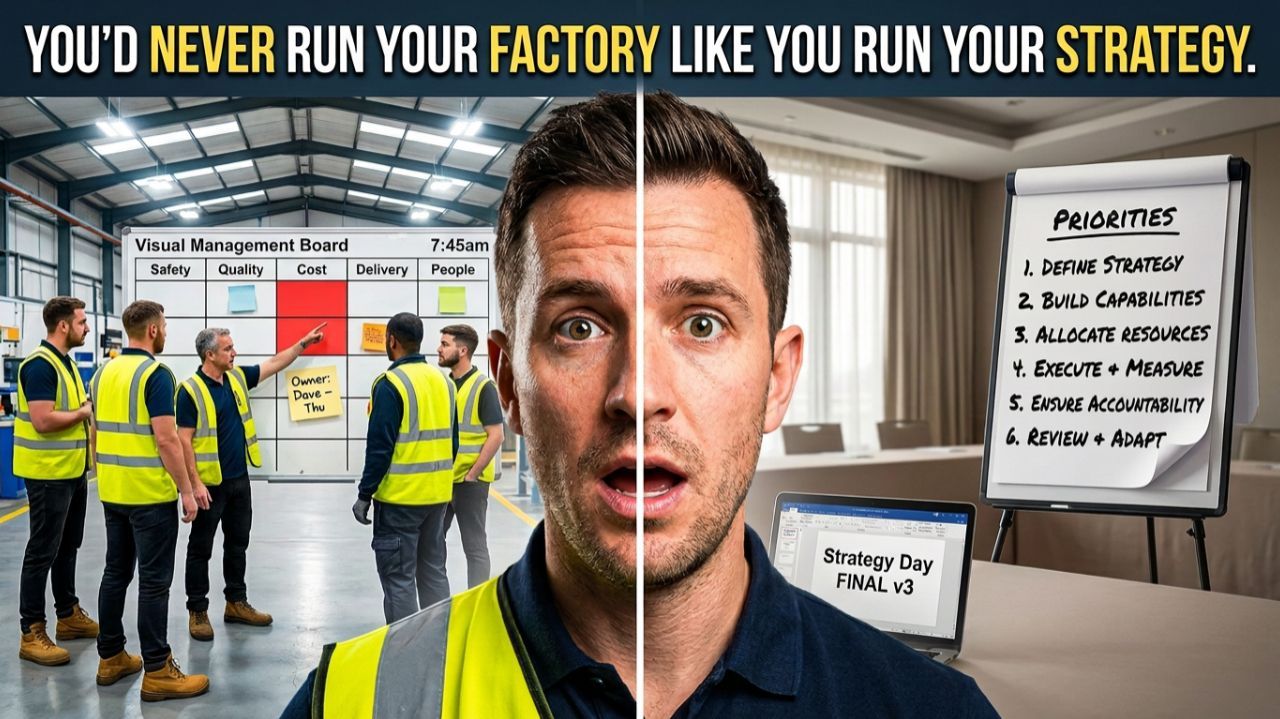
The third is leaving the list in the boardroom. If your shift supervisors and shop floor teams don't know what the actual three to five things are, they'll carry on optimising for whatever's on their local scorecard, which might have very little to do with what's genuinely determining your year. Getting this right often means changing what gets discussed in daily and weekly meetings, not just producing a nicer strategy document that sits in a folder nobody opens again.
And the last one, which catches out well-meaning teams more than you'd think, is confusing effort with impact. It's entirely possible for a team to work extremely hard, feel busy and genuinely useful, and still miss the year's real target because that effort wasn't pointed at the right things. Busy isn't the same as effective, and a factory full of hardworking people chasing the wrong priorities will still have a disappointing year, however good it felt along the way.
Bringing It Together
None of this is about measuring less, exactly. It's about being properly honest with yourself about what actually determines whether the next 12 months go well, particularly in a year carrying this much genuine pressure and this much genuine opportunity at the same time. Three to five things, not fifteen. Specific to your business, not copied from somewhere else, this article included. Revisited often enough to stay relevant, and known well beyond the boardroom, because the people actually running your machines are usually the ones who can tell you, often more accurately than the numbers can, what's really going to decide your year.
If you can't name what's critical for your business right now without opening a spreadsheet, there's a reasonable chance what you've got isn't a critical factor at all. It's just something familiar. Worth sitting with that thought for a bit.
Maybe put this down, get a coffee, and have an honest conversation this week with a few people across your business about what genuinely determines whether next year goes well. I can't promise a blog post will fix everything sitting on your plate right now. But it's a reasonable place to start.
If You Want More Than a Starting Point
To be fair, working through this on your own, with a notepad and a few honest conversations, will get you further than most manufacturers ever bother going. But if you'd rather not carry the whole thing alone, particularly the keeping them alive part above, which is genuinely where most businesses lose the thread, that's the exact gap the Implementation Engine at New Way Growth was built to close.
It's a 90 day programme built for engineering and manufacturing firms roughly in the £5 million to £25 million turnover range, and it starts in almost the same place as this article, a focused workshop to surface your actual Critical Success Factors rather than borrowed ones. From there it turns those factors into a single page operating system your teams can genuinely use, with clear owners, proper KPIs, and structured check ins at 10, 30, 60 and 90 days, so the plan doesn't quietly slide back into daily chaos by month two.
If any of this has felt a bit close to home, it might be worth a proper conversation.
Find out more about the Implementation Engine