It's Monday, half eight, and you're sitting in the meeting room just off the shop floor, the one with the slightly sticky table and the whiteboard that nobody has properly cleaned since spring. Someone has put last week's action list up on the screen.
You scan it. "Review scrap rates on Line 2: Production team." "Chase supplier on resin pricing: Dave/Sarah." "Sort out the forklift training records: ASAP." "Look at the new quoting template: ongoing."
And you already know, don't you? Before anyone says a word, you can tell that most of it hasn't moved since the last time you all sat round this table.
Nobody's lazy, and honestly that's the frustrating bit. Everyone in that room is working flat out, probably harder than they were two years ago, juggling customer pressure, staffing gaps and energy bills that still make the finance director wince. Dave genuinely meant to ring the supplier. Sarah assumed Dave had. The production team talked about scrap rates over a brew on Wednesday afternoon, which felt like progress at the time, although nobody wrote anything down.
I've sat in more of these meetings than I'd like to admit, on both sides of the table, and I think the underlying problem is almost always the same. Everyone's involved. Nobody owns it.
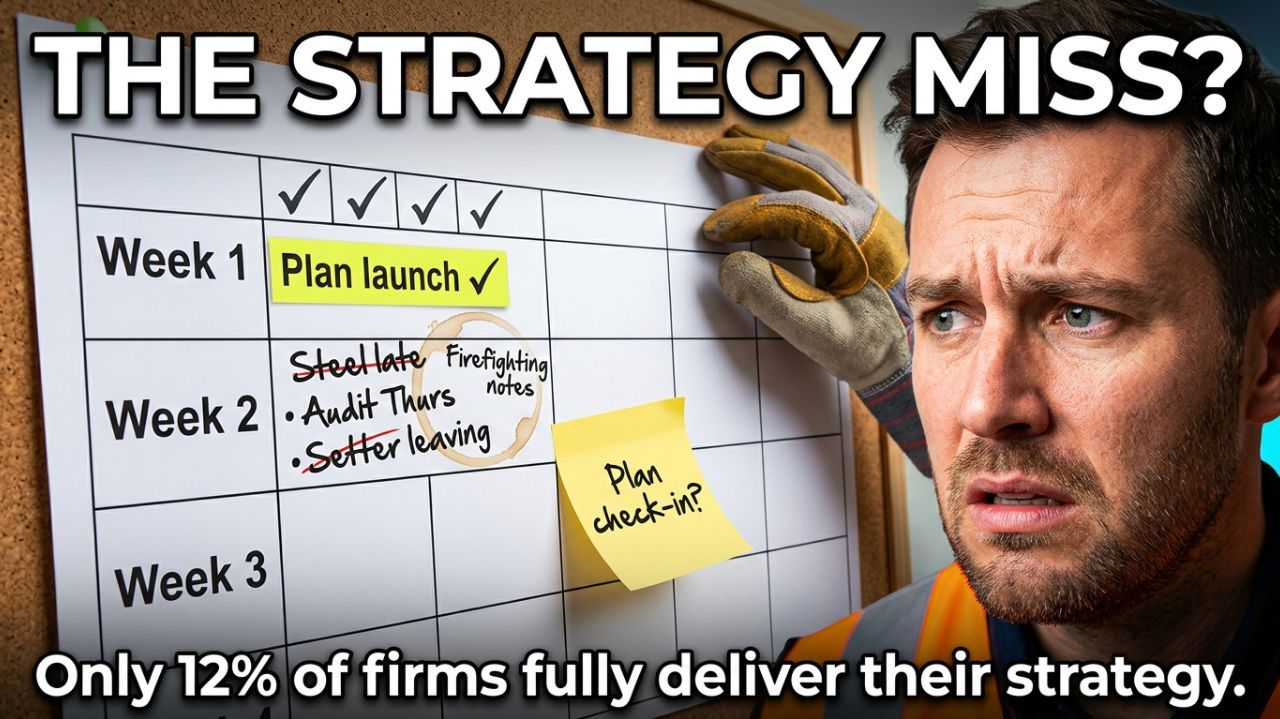
So here's the rule this whole post hangs on, and it's deliberately blunt. If it hasn't got one name and one date, it isn't an action. It's a hope. Maybe a good hope, maybe a well meant and perfectly sensible one, but a hope all the same.
If you run a manufacturing business turning over somewhere between £3m and £25m, this matters more than it might first appear. You don't have layers of middle management waiting to catch dropped balls, and you probably never will. What you have is a small senior team doing three jobs each, and an action list that seems to grow faster than it shrinks. Let's see if we can fix that.
Why involvement feels like ownership (and why it isn't)
Here's the trap. Putting several people on an action feels like the right thing to do, because it looks collaborative, inclusive and fair. In a close-knit firm, especially a family owned one where half the senior team have worked together for fifteen years, naming a single person can feel almost rude, as though you're singling them out in front of their colleagues.
So you write "Production and Quality" next to the scrap review. Or "Team". Or two sets of initials with a slash between them. Everyone nods, the meeting moves on, and the action quietly begins its long journey towards being forgotten.
The trouble is that shared actions don't behave the way your instincts suggest they will. There's a century old piece of research on this that I find oddly comforting, mainly because it proves the problem isn't unique to your particular lot. A French agricultural engineer called Max Ringelmann asked people to pull on a rope, first on their own and then in groups of various sizes. The total force went up as he added people, but nowhere near in proportion, because each individual pulled less hard as the group got bigger. Later psychologists gave this the rather unkind label of social loafing, and one of their most consistent findings is that it gets noticeably worse when each person's contribution is difficult to see.
That's your shared action, isn't it? When three people are on it, nobody can tell exactly who's done what, so everyone does a little less, not out of laziness but because it's entirely reasonable to assume that someone else has already picked it up.
Project managers worked this out a long time ago. If you've ever seen a RACI chart, the golden rule is that every task gets exactly one Accountable person. One. The guidance is remarkably consistent that two accountable people effectively means nobody is accountable at all. To be honest, you don't need the chart itself, and most firms your size would find a full RACI matrix more bureaucracy than it's worth. But the underlying principal travels very well.
Let me give you a real example. A few years back I worked with a precision engineering firm in the Midlands, about 70 staff, decent margins, genuinely good people. They had a tooling changeover that needed rethinking because it was eating nearly an hour of production time on every shift. The action on their list read "Tooling review: Mark, Jo, Gaz, Priya." Four capable, experienced people, and every one of them cared about getting it sorted.
It sat there for three months.
When we finally unpicked what had happened, it turned out that each of them had done a little bit. Mark had pulled some timings. Jo had spoken to the toolmaker. Gaz had developed a theory about the fixture, which turned out to be right. Priya was waiting for Mark's timings, which she didn't realise he already had sitting in a spreadsheet. Nobody was holding the whole thing, and crucially nobody was the person who'd feel slightly embarrassed if it hadn't moved by Friday.
We put one name on it. Jo's. The other three stayed involved and were genuinely useful throughout, but the changeover was redesigned and running within five weeks.
That's the distinction I keep coming back to. Involvement is about who helps, whereas ownership is about who answers. You can have as many helpers as the job needs, but you can only ever have one owner.
The One Line Test, explained
So how do you check whether an action is real? This is the part I like most, because it's almost embarrassingly simple.
Read the action in one line. Just one line. Can you see a single person's name and a single date? If you can, it passes. If you can't, it isn't an action yet, and it doesn't leave the meeting until somebody fixes it.
That's it. That's the whole test.
The name has to belong to a person. Not a department, not a shift, not "Quality" and definitely not "Team". Not two people separated by a slash either, because a slash is really just a polite way of saying "you two sort it out between yourselves", and in my experience they rarely do. If other people need to help, brilliant, write them in as support. But the name at the front of the line belongs to one human being who will answer for the outcome.
The date has to be an actual date, meaning a specific day of the month. "ASAP" isn't a date. Neither is "ongoing", "next week", "by the end of Q1" or my personal favourite, "TBC". I tend to think of those as moods rather than deadlines, because they tell you how someone feels about the task without telling you anything useful about when it'll be finished.
Why does the date matter so much? Part of the answer is straightforward psychology. There's a well-established body of research by Peter Gollwitzer and his colleagues on something they call implementation intentions, which is really just a technical name for deciding in advance exactly when and where you'll do something. A large review of 94 studies found that making that kind of specific plan had a medium to large effect on whether people actually achieved their goals. More recent and much bigger reviews suggest the effect shrinks once you correct for publication bias, so I wouldn't oversell it. But the direction of travel is clear enough. Vague intentions drift, while specific commitments tend to get done.
There's some more practical evidence too, and honestly it's the number that made me want to write this post in the first place. TeamRetro, a company that builds software for team review meetings, analysed hundreds of thousands of tracked actions. Items with both a named owner and a due date were completed around 90% of the time. Items with neither? Closer to 50%. And here's the real kicker: only about one in ten actions had been given a due date at all.
Now, I'll be honest about the limitations. That's one company's data, drawn from teams who already bother to use a dedicated tool, so it's probably flattering. It's also a correlation rather than a controlled trial, which means the kind of team that dates its actions might simply be more organised to begin with. But even if you halve the effect, it's still the cheapest improvement you're likely to make this year, because it costs you roughly ten seconds per action.
Here's what passing looks like in practice:
- Before: "Review scrap on Line 2: Production." After: "Pull scrap data for Line 2 and bring the top three causes: Kev, Thu 19 Nov."
- Before: "Chase resin supplier: Dave/Sarah, ASAP." After: "Get revised resin price in writing: Sarah, Fri 20 Nov. Dave to share last quote."
- Before: "Forklift training records: ongoing." After: "Confirm which drivers are out of date: Lisa, Wed 25 Nov."
Notice something else? The stronger versions all begin with a verb you can actually picture somebody doing. Pull, get, confirm. Words like "review" and "look at" are where actions go to die, because you can review something indefinitely without ever reaching a finished state.
Where it goes wrong in UK manufacturers
If this is so simple, why isn't everyone already doing it? I've got a few theories, and they're mostly about the particular shape of businesses your size.
The first is what I'd call the MD problem. In a lot of owner managed firms, any action without a clear owner quietly becomes the managing director's. Not officially, of course, and nobody ever writes it down. But when the customer rings about the late order, or the auditor asks to see the training records, it lands on your desk because you're the person who cares most about the consequences. I've watched managing directors carry twenty or thirty of these invisible actions around in their heads, wondering why they're working sixty hour weeks while the action list stays stubbornly the same length.
The second is that memory and goodwill scale badly. When you were 15 people, you didn't need any of this, because everyone could see who was doing what simply by walking across the factory. At 40 people it starts to creak. By 60 or 80, with two shifts and perhaps a second site, it's quietly broken, but because nothing dramatic exploded, nobody noticed the moment it stopped working.
And it really isn't just you. The ONS has been surveying how British firms are managed for several years, and manufacturing doesn't come out of it particularly well. In their large Management and Expectations Survey, manufacturing and construction scored below the all industry average for structured management practices. The weakest area across every type of firm was how well businesses tracked and reviewed their key performance measures. Family-owned firms, which made up roughly two thirds of those surveyed, scored lower than non-family firms on average, and an earlier ONS study of manufacturers found family-owned businesses around 20% less productive.
I don't say that to have a go at family businesses, and I've worked with plenty that run rings round their corporate competitors. But there's a pattern worth noticing. Where everyone "just knows" how things work, nobody writes down who's actually on the hook.
Why does this matter more right now? Mainly because the extra people aren't coming. Make UK's latest outlook shows that manufacturers have almost stopped adding staff, with the recruitment balance falling from +15% to +3% between the second and third quarters of 2026. Costs remain high and firms are understandably cautious, so the same people are carrying a heavier load. And when a team is stretched, unowned actions are always the first things to slide off the edge of the table.
One more story, because this one still makes me wince. A food packaging client of mine, turning over around £12m, had an action sitting on the list for weeks: "Update allergen labelling process: QA/Production." Both departments believed the other had it in hand, and neither did. It only got sorted when a retailer flagged a labelling error, at which point the whole thing became a very expensive and very stressful emergency. Afterwards, the operations director said something that has stayed with me ever since: "It wasn't that nobody cared. It was that everybody cared a bit."
Exactly that.
Running the test in your next meeting
Right, here's how I'd actually do it, starting this week. You don't need new software, and you certainly don't need a consultant. What you need is about five minutes of mild awkwardness at the end of each meeting.
Read every action out loud before anyone leaves the room. Not just the new ones, all of them. For each one, ask the same question: one name, one date? If it fails, fix it there and then, while everyone is still sitting down.
When an action hasn't got an owner, ask "whose name goes on this?" and then stop talking. This is genuinely the hardest part. There'll be a silence, and someone will suddenly find their coffee fascinating. Let it sit. In my experience the right person usually volunteers within about ten seconds, and if nobody does, you've learned something useful about that action. Perhaps nobody believes it matters, in which case you should bin it.
That point deserves a moment on its own, actually. Some actions fail the test because they shouldn't exist in the first place. If you can't persuade anyone to put their name against something, perhaps it isn't really a priority, and a shorter list you finish will always beat a longer one you don't.
Let the owner choose the date. That might sound soft, but it isn't, because people defend dates they've chosen far more fiercely than dates, they've been handed. Your job is simply to challenge the date if it's unrealistic in either direction. "Friday? With the audit on Thursday? Are you sure?" And insist on a day rather than a week, because "week of the 23rd" quietly gives everyone permission to start thinking about it on the 27th.
If other people need to contribute, write them in after the owner's name, so the line reads something like "Sarah, Fri 20 Nov, with help from Dave." It keeps the helpers visible and properly credited without muddying who's answerable. I've found this one small change takes most of the sting out of naming a single owner, because nobody feels excluded.
Start every meeting with last week's list, before any new business. Work through it quickly: done, not done, new date. It takes five minutes and it changes the whole tone of the meeting, because people know they'll be asked. Not shamed or interrogated, just asked.
When an owner can't hit their date, that's absolutely fine. Things happen in manufacturing. A big order lands, a machine goes down, someone's off sick for a fortnight. Let them move the date once, openly, in the meeting, and record the new one. What you're really trying to prevent is the silent slide, where a date gradually stops meaning anything to anyone.
And count. Honestly, this is the bit most firms skip. Every week, note how many actions were due and how many were completed by their date. You'll find plenty of statistics floating round online, like the widely repeated claim that 44% of meeting actions never get done, and many of them are surprisingly hard to trace back to anything solid. So don't rely on somebody else's number when you can measure your own. If you're completing 50% on time now and you're at 75% in two months, you'll feel the difference on the shop floor long before it shows up in the management accounts.
One last practical point. Keep the list somewhere everyone can see it between meetings. A shared spreadsheet works fine, and so does a whiteboard in the production office. What doesn't work is the list living in one person's notebook, which, if we're honest, is usually yours.
Conclusion
If you take just one thing from this post, let it be the difference between involvement and ownership. Involvement is good, and you want people helping, contributing and chipping in with ideas. But ownership is singular: one person who'll answer for the outcome, and a date that turns good intentions into something real.
The evidence points the same way from several directions. Group effort thins out when individual contribution is hard to see. Specific plans tend to beat vague intentions. And in one large dataset, owned and dated actions were completed about nine times in ten, compared with roughly half for the rest, even though hardly anyone bothered to date them. The ONS data suggests manufacturers have more ground to gain here than most sectors, and with recruitment almost flat, you need every action your team agrees to actually land.
So here's my challenge, and it's a deliberately small one. For the next 30 days, run the One-Line Test at every management or production meeting you hold. Read each action aloud, check for one name and one date, and fix it or bin it before anyone leaves. Start each meeting with last week's list and count what was completed on time.
I'd be surprised if you don't notice a difference within a fortnight. Maybe not in the numbers straight away, but certainly in the meeting itself, which tends to get shorter, a little less weary and noticeably more honest. People start saying "that one's mine" without being asked.
And the next time you see "Team" or "ASAP" on your plan, you'll know exactly what you're looking at. Not an action, just a hope with a bullet point.
One name. One date. Or it isn't an action. And if you'd like a hand making that stick across your whole business, not just in one meeting, that's exactly what our
Implementation Engine programme is built for. Over 90 days we work with your leadership team to agree two to four clear priorities, put one named owner and one date against every action that matters, and then check in at 10, 30, 60 and 90 days so nothing quietly drifts. If that sounds useful,
book a call with our founder Adam Payne. There's no hard sell, I promise, just an honest chat about where you are now and where you want to get to.