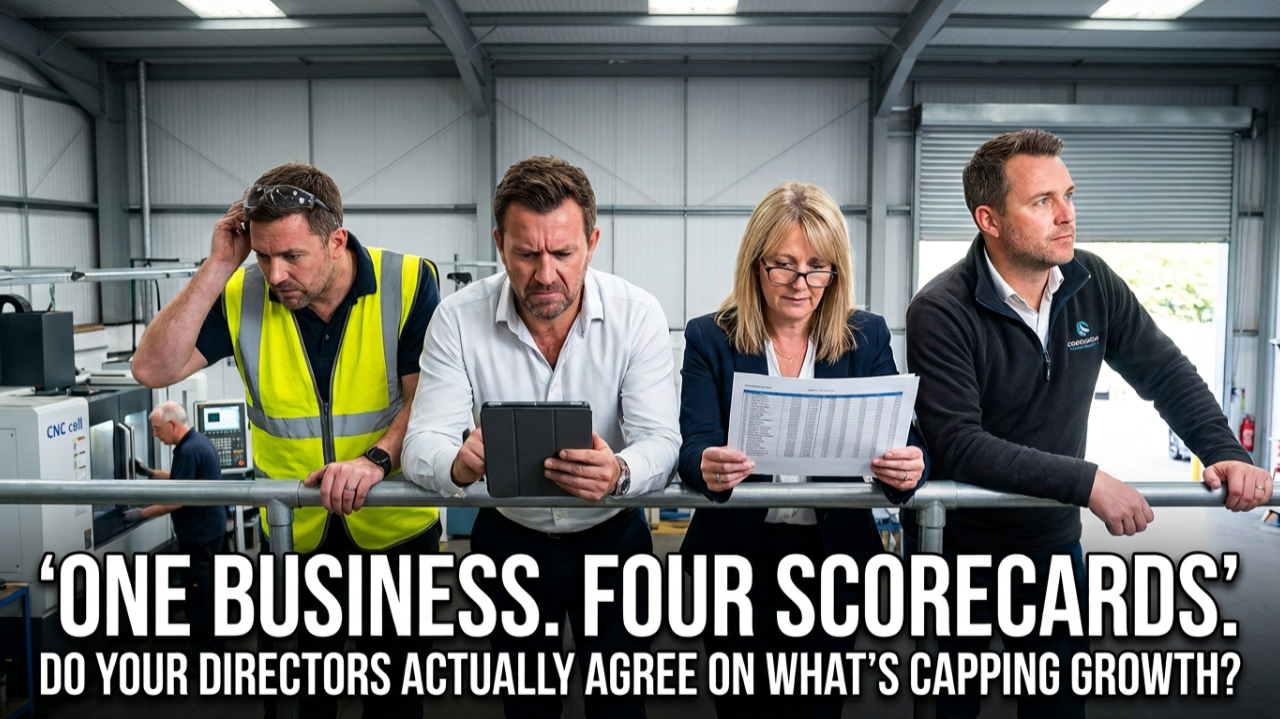
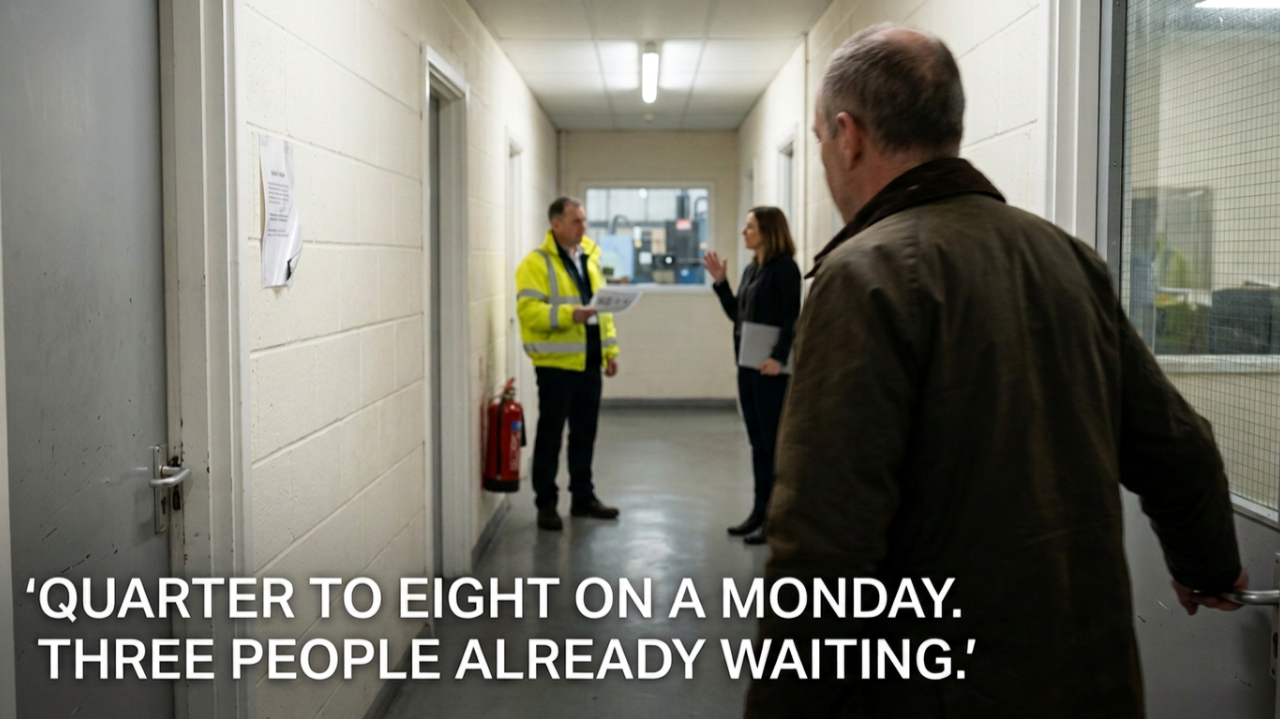
I want you to picture two pieces of paper.
The first is in a clear plastic sleeve. It's beautifully laid out. Vision at the top, a three-year picture, one-year goals, quarterly priorities, a tidy scorecard down the side. It was printed in colour after a two-day workshop last January, and it now lives in the second drawer of a filing cabinet in the MD's office. If you asked, somebody could find it. Probably.
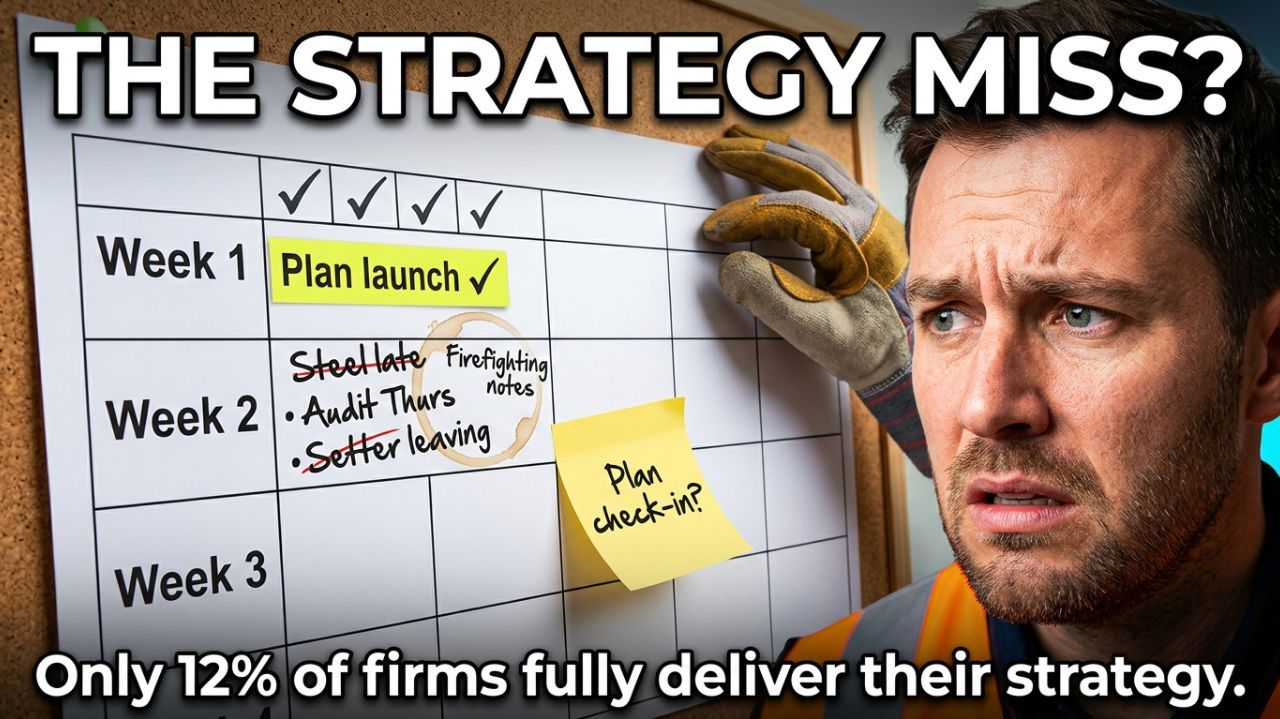
The second is an A3 sheet pinned to the wall of a meeting room just off the shop floor. It's a bit tatty. There's a coffee ring in the bottom corner. Two of the priorities have been crossed out in biro, each with a date and a scribbled reason next to it. One of the measures has been rewritten three times. There's a yellow sticky note in the margin that says "ask Dave about the tooling quote, Thurs."
Which one belongs to the business that's hitting its numbers?
You already know. I'd guess you've worked in both kinds of business, maybe even run both. And I'd guess, if you're being honest with yourself, there's a small nagging feeling that yours looks more like the first one than you'd like.
I call this the coffee ring test, half-jokingly. An operating system that's being used gets marked. It gets handled, scribbled on, argued over and changed. One that's been filed stays clean. And clean, in this particular case, is a bad sign.
I've spent a lot of the last few years sitting in owner managed engineering and manufacturing firms turning over somewhere between £3m and £25m. Precision machining, fabrication, sheet metal, specialist assemblies, the odd food line. Almost every one of them had some kind of plan. Far fewer had a plan that anyone was using. The difference between those two groups wasn't intelligence, or effort, or even the quality of the plan. It was whether the thing had become part of the week.
So this post is about what that looks like in practice. Not the theory of business operating systems, there's plenty of that around already. What it looks like on a wet Monday morning when the system's actually alive.
You already have an operating system. It just isn't the one in the folder
Let's get the jargon out of the way first.
"Business operating system" gets used a lot now. You'll probably have come across EOS, from Gino Wickman's book Traction, with its two-page Vision/Traction Organizer. Or Scaling Up, from Verne Harnish, built around the One-Page Strategic Plan. OKRs, if you've read anything from Silicon Valley. Hoshin Kanri, if you came up through lean. Funnily enough, a few of these grew up in factories in the first place. EOS and the Great Game of Business both have roots in manufacturing, where predictability and repeatability were the whole game.
But the definition I like best isn't a branded one. One UK advisory firm puts it simply: your business operating system is the way your company actually runs. The real rhythm of meetings, priorities, decisions and accountability. Not the poster on the wall. Not the offsite deck.
Which means every business has one. Every single one. The only question is whether it's the one you designed.
In a lot of firms your size, the real operating system goes something like this. The MD's inbox decides what's urgent. The loudest customer decides what's important. The daily production meeting runs like clockwork, because it has to, and everything above it runs on corridor conversations and whoever catches the boss before he heads home. That's an operating system. It's just not a very good one, and it stops working at the point where one person can no longer hold the whole business in their head.
Then, usually somewhere around £5m or £6m, something prompts a change. A bad year. A new FD. A book someone read on holiday. There's a workshop, a framework and a lovely document. And for a few weeks, maybe a couple of months, the new system runs alongside the old one.
Then the old one wins. It nearly always wins, because it's the one that's wired into the week.
Simon Wakeman, a UK business coach, wrote recently about a founder who'd invested properly in a business operating system and, within months, found the quarterly priorities weren't being updated, the scorecards were half filled in and the weekly meeting had turned into a box ticking exercise. When he dug into it, the problem wasn't the operating system itself.
That's the bit I'd underline twice. The framework is rarely the problem. EOS works. Scaling Up works. OKRs work. A well-kept spreadsheet works, to be honest. What doesn't work is a system that's been installed but never adopted. It's a bit like buying a new machining centre and leaving it shrink wrapped in the corner because the old one's "fine for now."
Seven signs your operating system is actually being used
So how do you tell the difference? Here's what I look for when I walk into a business. None of it's scientific. All of it's surprisingly reliable.
1. It's been changed recently. Look at the date on it. A live system has been touched this week, or last. A filed one carries the date of the last workshop. And if the file name has "FINAL v3" in it, that's usually where it stopped.
2. It's in the room when real decisions get made. When there's a big quote on the table, or a new hire, or a capital spend, does anyone get the plan out? Does somebody ask, "does this help with priority two or not?" If the plan only ever gets looked at in the meeting about the plan, it's filed. Simple as that.
3. The meeting happens in a bad week. Anyone can hold a review when the order book's calm. The real test is the week a key customer's line goes down, you're two operators short and the auditor's in on Wednesday. In a business that uses its system, the meeting gets shorter in a bad week. It doesn't get cancelled.
4. Your supervisors can explain it in their own words. Not recite it. Explain it. Go and ask a team leader what the business is trying to achieve this quarter and why their cell matters to it. If they can tell you, even roughly, the system has made it out of the boardroom. If they look at you a bit blankly, it hasn't.
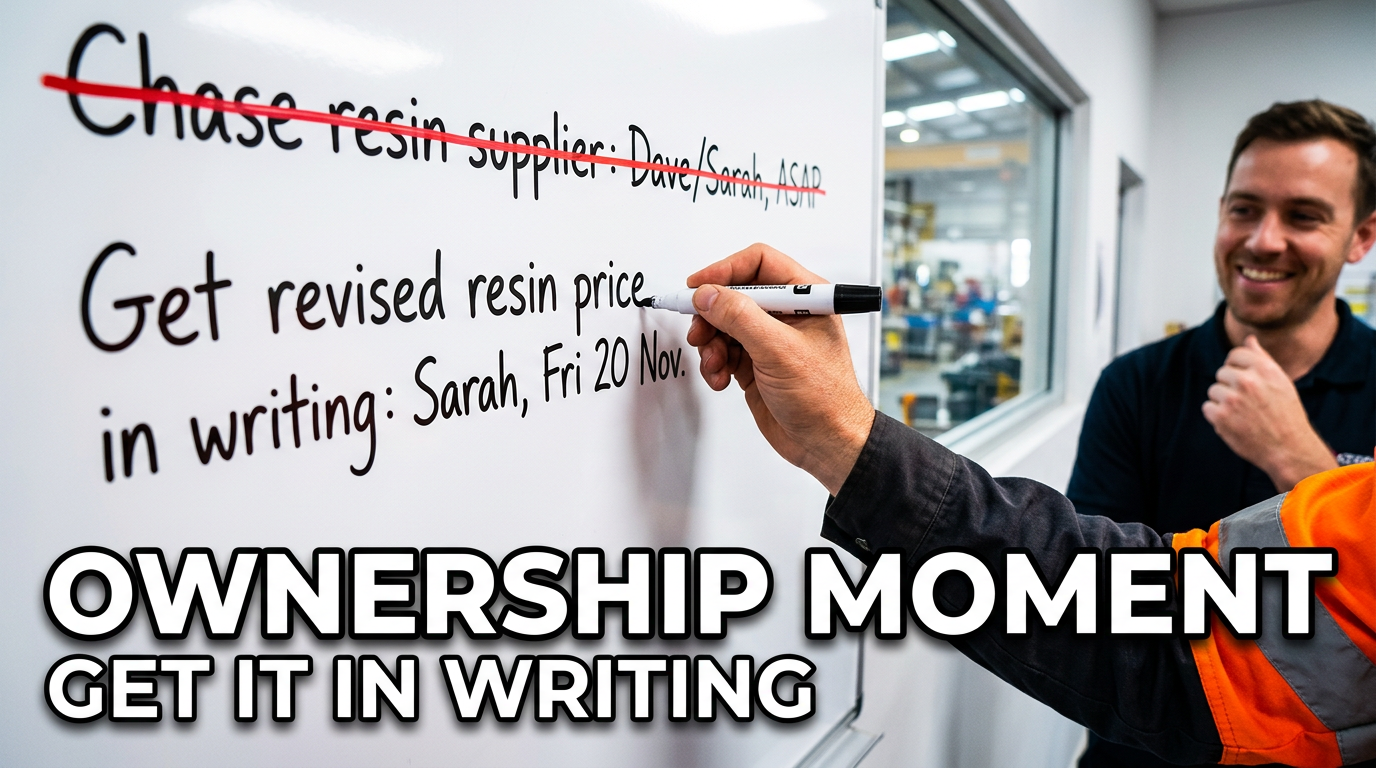
5. Red means a name and a date. In a filed system, a red measure is a talking point. Everyone has a view, nobody leaves with an action. In a used system, red is a trigger, the same way it is on your production board. Somebody owns it, there's a next step, and there's a day by which you'll know whether it worked.
6. Things come off it, on purpose. I actually get more confident when I see crossings out. A live system drops priorities out loud, with a reason, because the world changed or the job got done. A dead one just has things on it that nobody mentions any more.
7. It's a bit boring. Honestly. The best ones I've seen are almost dull. Same slot every week, same page, same three questions. Nobody's especially excited about it. Nobody needs to be. Excitement belongs at the workshop. The operating system is the bit after.
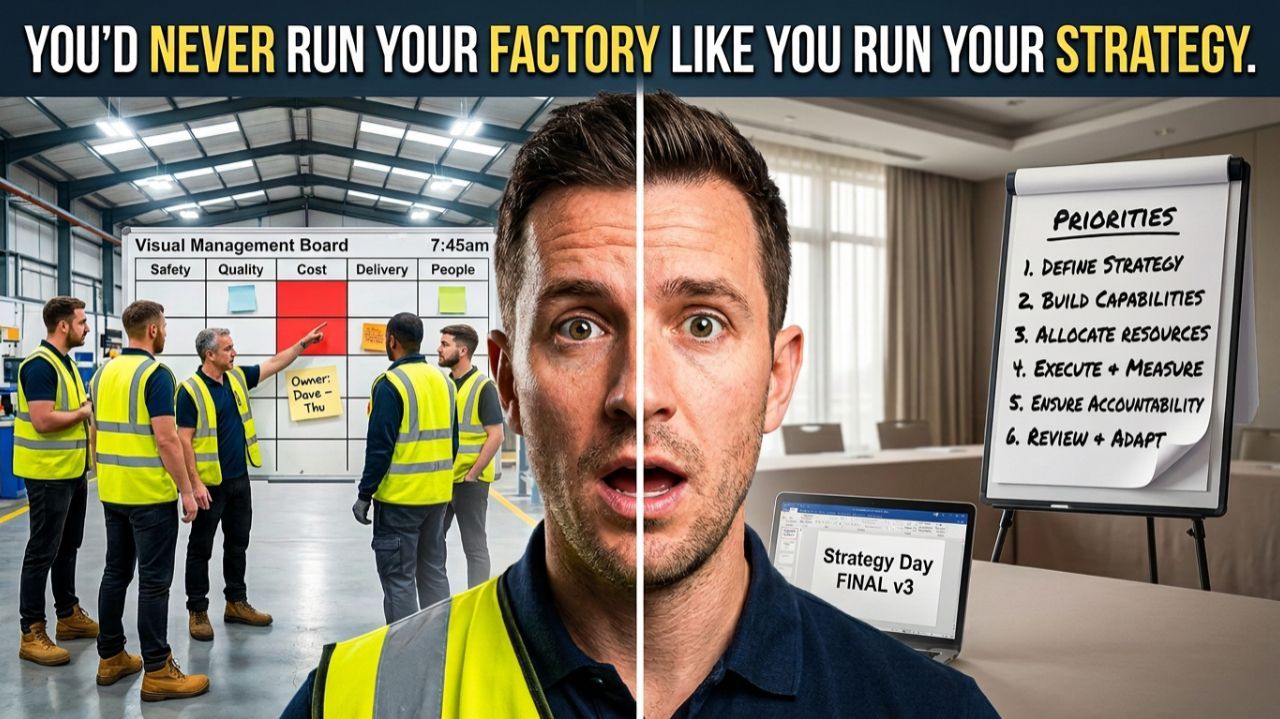
I remember walking round a precision engineering business, about £14m, a couple of years ago. In the boardroom they had a strategy board that was genuinely lovely. Professionally designed, vinyl printed, mounted on the wall. Visitors loved it. I asked the operations director when it had last been updated and he laughed and said, "probably when the printer came to fit it."
Meanwhile, twenty metres away on the shop floor, the daily production board had been wiped and rewritten every single morning for about six years.
Same people. Same building. Two completely different relationships with a board. I've thought about that a lot since.
Why it ends up in the drawer, especially in firms your size
I don't think filed operating systems are a laziness problem. The people I work with are some of the hardest working leaders you'll meet. There are better explanations than that, and some of them show up in the data.
The Office for National Statistics runs something called the Management and Expectations Survey. It scores firms from 0 to 1 on structured management practices across four areas: continuous improvement, the use of KPIs, the use of targets, and people practices like promotion, training and dealing with underperformance. The most recent round, covering 2023, found the average score had risen to 0.57, up from 0.51 in 2020. Good news, broadly.
But look a bit closer. Firms in the production sector scored lower on average (0.54) than services firms (0.58). Bigger firms consistently scored higher than smaller ones. And in earlier rounds, KPIs were the weakest of the four areas.
Sit with that for a second, because I think it's a bit odd. Manufacturing is where daily boards, SPC and root cause analysis were born. And yet, on structured management of the business as a whole, manufacturers score below the services sector. That fits exactly with what I see. Brilliant at managing the process. Much weaker at managing the business.
Ownership plays a part too. When Nick Bloom, John Van Reenen and their colleagues linked UK management survey data for around 8,000 firms to productivity figures, they found management scores were much lower in family-owned businesses, especially those run by family members. I want to be careful here, because some of the best firms I've ever worked with are family businesses. But it does tend to mean the system lives in one or two people's heads. Writing it down feels like admin rather than management. And anything that feels like admin is the first thing to go when things get busy.
That matters more than it might seem. The Productivity Institute, commenting on the same ONS survey, points out that higher management scores are statistically linked to higher labour productivity. This isn't a soft, nice to have thing. It shows up in output per head.
Then there's the pressure you're under right now. Make UK's Q3 2026 Manufacturing Outlook, published with S&W, showed the employment balance dropping from +15% in the second quarter to just +3% in the third, with manufacturers holding off on hiring because of cost and uncertainty. ONS figures show 81,000 fewer manufacturing workforce jobs in the year to March 2026. So you've got the same work, or more, and the same people, or fewer. When something has to give, it's never the order going out on Friday. It's the meeting about the plan.
On top of all that, there are a few design faults I see over and over again:
- It's too big. The template came from a book written with a 150-person business in mind, and you're 60 people with one director doing three jobs.
- It belongs to someone else. It's a consultant's format, or it's one director's pet project, so nobody else feels it's theirs to update.
- It has no slot. It gets "covered at the monthly," which really means it gets the last ten minutes after the management accounts, the health and safety update and the customer complaint that ran over.
- It isn't connected to the daily. The production meeting and the strategic plan never touch. Not once.
That last one is the big one, I think. If there's no thread running from the plan on the wall to the board on the shop floor, the plan will always lose. The shop-floor board wins because it's tied to something real happening today.
What a used operating system looks like in an ordinary week
Let me make this concrete. What follows is a sort of composite of several firms I've seen do this well. None of them did it perfectly. All of them did it consistently, which turns out to matter a lot more.
Monday, 8.30am. The leadership team stands round the one-page plan for fifteen or twenty minutes. Not sat round a table with laptops open. Stood up, at the page. For each priority there are three questions. Are we on track? What's in the way? What's the next action and who owns it? Anything red gets a name and a date. Anything that needs more than a couple of minutes of discussion gets taken offline to a separate conversation, with the right two or three people, later that day.
Tuesday to Friday. The daily production meetings carry on as normal. But on the board, there's one line that links upwards. Maybe it's the lead time measure that feeds priority one, or the scrap rate tied to the margin priority. The supervisor doesn't need to understand the whole plan to move that line. They just need to know it matters and that someone above them is looking at it every Monday.
In between. The page gets used to make decisions. A customer asks for a rush job that'll push the tooling project back a fortnight. Somebody asks, out loud, which one matters more this quarter. Sometimes the rush job wins. That's absolutely fine. It's a decision, made on purpose, and it gets written on the page. What you're trying to avoid isn't change. It's drift.
Once a month. A proper numbers review. Not just the management accounts, but the handful of KPIs that tell you whether the priorities are working.
Once a quarter. A reset. Retire what's done. Drop what's no longer right. Pick the next few. Ask whether the system itself is working, or whether the Monday meeting has started to slide.
None of this is new, by the way. David Mann, in Creating a Lean Culture, argued that a lean management system rests on four things: leader standard work, visual controls, daily accountability and leadership discipline. He's quite clear that leader standard work isn't a record keeping exercise. It's meant to be a working tool that leaders carry around with them and use to guide what they do each day. That's really the difference between used and filed, in one sentence.
Mann also gives a rough guide to how much of a leader's time should be standard routine. For team leaders it's around 80%. For supervisors, about half. For executives, roughly 10%.
Ten per cent. For you, that's about four hours a week. I don't know many MDs who wouldn't take that deal: a system that needs a tenth of their time and gives them a lot more control over the other nine tenths.
I worked with the MD of a fabrication business, about £6m, whose plan was the tatty A3 sheet with the coffee ring I described at the start. Yes, that one's real. A few months in, I asked her what had changed most. I assumed she'd say the numbers, which had improved. She didn't. She said, "I've stopped getting ambushed. Things used to land on me at four o'clock on a Thursday. Now they come up on Monday morning, when there's still time to do something about them."
I think that's what a used operating system really buys you. Not a better plan. Earlier warning, and a bit of your week back.
How to get yours out of the drawer, starting next Monday
If you've read this far and you're thinking, "right, ours is definitely in the drawer," that's fine. Most are. Here's where I'd start.
Shrink it to one page. Three priorities. Four at an absolute push. For each one, a single owner, a measure you'd expect to move within 90 days, and the next action. If it won't fit on one page, you've got too many priorities, and you probably know which ones are padding.
Give it a slot that never moves. Monday morning works for most manufacturers, because it sets the week up. Fifteen minutes, same time, same place. It happens in the mad weeks. Especially in the mad weeks.
Print it and write on it. I'm half serious about the coffee ring. A sheet you can scribble on gets used far more than a file you have to go and open. If you'd rather keep it digital, that's fine, but put it on a screen in the room so it's physically there during the conversation, not buried three folders deep on the shared drive.
Put a name on every line. Not "Operations." Not "the team." A person. If two people own something, nobody owns it.
Let it make a decision this month. Use the page to say no to something. A project, a request, a nice idea from a customer. Nothing proves a system is real faster than seeing it change what actually happens.
Inspect early. Don't wait for the quarter end to find out a priority never got going. Check in at ten days. Think of it like a first off inspection. It feels almost too early to bother, but it's the one that catches the priority that was never properly set up in the first place.
Review the system, not just the results. Every quarter, spend ten minutes on the system itself. Is the Monday meeting still happening? Is it still fifteen minutes, or has it crept to fifty? Is the page still the right page? A production system needs maintenance. So does this one.
If you'd like a hand doing this properly, it's exactly what our
Implementation Engine is built for. It's a 90-day programme for UK engineering and manufacturing firms turning over £3m to £25m, designed for leadership teams whose strategy is sound but keeps getting lost in what we call the Fog of Daily Chaos.
We start with a Deep Dive diagnostic, an honest and non-judgemental look at where the business really is. Then a hands-on Blueprint workshop where your team identifies the Critical Success Factors that will make or break the next year and turns them into clear objectives. That becomes your VTA Matrix™, a one-page operating system designed from day one to be used every Monday morning, not filed. Each priority gets two to four OKRs, KPIs to measure progress, and action items with a named owner and a deadline. Then we hold the rhythm with structured check ins at 10, 30, 60 and 90 days, so it keeps going when the factory gets busy, which is exactly when most plans quietly give up. The full programme is £7,500 plus VAT, with payment options available.
If you'd like to talk it through first, you can
book a call. It's a conversation, not a sales pitch. We'll look at what your current plan looks like, and whether it would pass the coffee ring test.
Pass the coffee ring test
Let's pull it together.
Every business has an operating system. The question is whether it's the one you designed or the one that grew up around the MD's inbox and the loudest customer. Most firms your size have tried to design a better one at some point. Most of those designs ended up in a drawer, not because the framework was wrong, but because it never became part of the week.
You can tell a used system from a filed one pretty quickly. It's been changed recently. It's in the room when decisions get made. The meeting happens in a bad week. Supervisors can explain it. Red means a name and a date. Things come off it on purpose. And it's a little bit boring.
The data backs up what most of us feel. Structured management, especially the regular use of KPIs and targets, is where manufacturers and smaller firms tend to fall behind, and it's linked directly to productivity. Right now, with tight labour and high costs, it's also the first thing to get squeezed.
The fix isn't another workshop or a better template. It's one page, a fixed slot, a name on every line, an early check, and the discipline to keep going in the weeks when it feels like you can't afford to. Your shop floor already runs like this. Your plan can too.
So here's a small challenge for this afternoon. Go and find your plan. The actual document. Look at the date it was last changed. Look for any handwriting on it. Ask yourself when it last changed a decision.
If it's spotless, it's probably filed. And it might be time to get it a bit dirty.